Skip to content

Using the Syllabus as a Planner through the Review Function in Word

Faculty joke about how often we tell students “It’s in the syllabus!”  But what if the answers that we  faculty wanted for what we are doing in the course were in the syllabus?  The syllabus is a funny document to me because officially it is for students, but I also use it for myself to remember what the class is supposed to be doing in any given class meeting.  The problem is that I don’t want to put all the information that I need for planning on to the same document that students get.  This is not because I want to keep it to myself, but I think an overwritten syllabus can be distracting and confusing.  And sometimes as the course progresses, the planning changes. Read more

How the NPR / Scientific American story on Men and the Environment Exemplifies the Fate of Humanities and Gender Studies in the Public Square

On December 30, 2017, NPR ran a story about a write-up for Scientific American that a marketing professor did on his research into the reasons men are less likely to engage in environmental activity than women.  His earth-shattering conclusion was that men think that caring for the environment is not manly.  His recommendation was to market caring for the environment as more manly.

I want to suggest that what happened here points to three different issues facing the academy concerning humanities scholarship.  First, research outside of the humanities often fails to see the ways that the humanities have contributed to the field of knowledge under discussion and so treats its own insights as original and is impoverished for ignoring the long history and consideration of these questions in the humanities.  Second, more specifically, gender studies fails to be treated as a discipline or a form of study that produces original research that people making claims about gender should be aware of.  As a result, people make overdetermined and weighted claims without even understanding their significance and implications.  Third, when people who are in positions with more access to the public present their work as if it is original when the claims have been made at great length the difficulty at crying foul, at suggesting that this research is derivative and not well-researched, points to the difficult the humanities have in being recognized as a producer of knowledge. Read more

High Insurance Health Plans/ HSAs and the Logic of Neoliberalism

This post could have been called, “And then they came for me.”  My employer is self-insuring and has experienced recent spikes in health care costs.  Several years ago, employees saw their premiums rise considerably and last year they rose even higher.  To respond to employee frustration with these increased costs that employees were asked to shoulder, my employer has now begun to offer high deductible health plans (HDHPs).  HDHPs offer free preventative care, but everything else for the first $6000 or so (plans vary) must be paid out of pocket, negotiated at the insurance company’s rate, by the patient.  After that, patients are responsible for 20% of costs.  Alongside the HDHP, patients can set up a Health Savings Account (HSA).  Patients can place a pre-tax portion of their paycheck into the HSA and draw on it through a card, like a flexpay account, but this account rolls over year to year.  My employer is putting some money each year in each person’s HSA who chooses to take it.  At this time, employees still have the option of taking the high premium regular insurance.

I have signed up for the HDHP and an HSA.  The HSA is managed by a third party company, Employee Benefits Corporation who is paid by my employer to manage the HSA.  Several days ago I received an email from Employee Benefits Corporation.  The first line read, “Congratulations, this is your important first step to becoming a better healthcare consumer!”

From what I have described you can see how the HDHP and the HSA are meant to encourage patients to think of their health care as consumers and not as patients.  This plan is how Republicans want to address health insurance coverage.  Such a plan supposes that patients should think of health care as consumers who have to make wise chooses about how to use their money.  I already started thinking like that in the transition to the HDHP.  In December, I had a test done that I probably would have waited on and maybe never had done if I would have had them covered in the New Year, but I knew that I wouldn’t have coverage in the New Year.  I also got a prescription filled early in order to get it filled under the previous health insurance coverage. Read more

Exercising Under Neoliberalism

This post originally appeared on Fit is a Feminist Issue and is crossposted with permission.

The strange algorithms of Facebook brought Sam B’s post from several years ago–“Am I really lapping people on the couch?”–to my feed last week.  People like to talk about their athletic efforts and workout regimes in terms of how they are doing better than other people.  At the yoga studio where I practice they regularly say at the end of class, “You did more in the last hour than most people will do this entire day.”  This sentiment  suggests that I did something worthwhile because it was better than what other people are doing.

But I hesitate to just blame my fellow athletes for thinking about our physical efforts in this way.  This way of thinking is exercising under neoliberalism.  If liberalism underwrites capitalism through the idea that individuals bear responsibility for their position in the world and private property requires the protection of the government, resistance to liberalism came from workers organizing for their rights against the ownership class.  Neoliberalism demands that workers be considered as individuals, not as a collective with shared interests.  If labor opposed capital under liberalism by arguing that labor is the source of wealth production, under neoliberalism workers themselves are viewed as human capital, and as human capital, of being responsible for their own precarious situation that being workers puts them in.  As human capital, the workers bear their own risks.  Under liberalism, workers could demand that working conditions be improved to protect them because they argued that their well-being was necessary for wealth production.  Under neoliberalism, workers are made responsible for the conditions. Read more

Book Review: Ömer Aygün’s The Middle Included

I volunteered to review this book for a scholarly review site in a field that is adjacent to mine.  I was asked to rewrite it because it did not accord with the standard ways of speaking about Aristotle.  I pulled the review and am publishing it here.  I mention this background because I think it is worth noting how deep a hold the traditional approaches to Aristotle have.  This hold makes people assume there is no more interpretation to be done on Aristotle.  It makes some scholars resistant to new and fruitful approaches that recover Aristotle from scholastic approaches.  It makes them assume that logic is clearly and obviously distinct from ontology and ethics.  Aygün offers a careful reading of the text to challenge this approach to Aristotle and by doing so contributes to the growing scholarship that unsettles a tradition that takes these questions to be settled.

Aygün, Ömer. The Middle Included: Logos in Aristotle. Evanston, IL: Northwestern University Press, 2016. xv, 272 p. $34.95 (pb). ISBN 9780810134003

It is a difficult and remarkable task to say something new about the whole of Aristotle’s philosophy.  Such is the project Ömer Aygün undertakes in The Middle Included: Logos in Aristotle to argue that Aristotle is not a thinker of the excluded but the included middle. Aristotle is traditionally understood as the father of logic based on his articulation of the law of non-contradiction.  The law of non-contradiction is both a logical and an ontological principle because Aristotle thinks that what is must be knowable, and insofar as it is knowable, it follows the principles of knowledge.  The law of non-contradiction, that the same thing cannot be said to be and not be of the same thing in the same respect at the same time, is the most reliable principle of knowledge for Aristotle.  But it is also a principle of being because it is not just that it cannot be said, but the same thing cannot be and not be at the same time and in the same way in a subject.  The middle is excluded because if something is said to be of a thing there is no middle position wherein it could also be said not to be.  The middle is excluded because what is and what is not must be held apart.

Aygün offers a novel interpretation of this law by arguing that logos puts into relation that which is opposed and hence, is the middle that has traditionally been thought to be excluded. Logos, Aygün argues, joins what is opposed—contraries–without reducing or sublating what is opposed.  The traditional language of Aristotelian scholarship understands logos in terms of logic as a formal system or speech as a mechanism for communicating personal thoughts to another.  This language distances the contemporary reader from the richness of Aristotle’s language that shows the human being to be formed by logos in a way that conceives of the human as a being that draws the multiplicity of the world into a unity. The apparent strangeness of Aygün’s language is necessitated by the demand to make what we suppose is obvious in Aristotle become a question again.  His account of logos makes the human being “the middle included,” because, through logos, which he describes as a mediation, a synthesis, and a stretching, the human being joins together the difference and multiplicity that constitutes the world.

Read more

HuMetricsHSS: Can (Should) We Develop Humane Metrics for the Humanities?

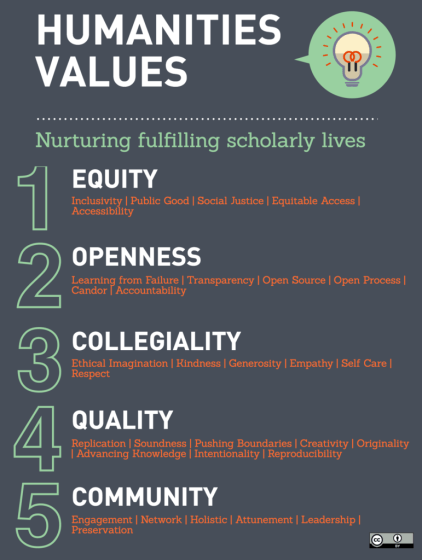
I just got back from a three-day workshop in East Lansing whose goal was to bring together people from diverse locations within the academy and adjacent to the academy to think through a proposed set of values for measuring humanities research in the academy.

The HuMetricsHSS team had developed this framework at TriangleSCI.  Now they wanted to see whether people agreed that these were the shared values that people in the humanities have.  They invited chairs and faculty from public research institutions, land-grant institutions, small liberal arts colleges, community colleges, and librarians and people working at Academic Research Centers on college campuses, and graduate students.  For the tl;dr, skip below.

humanities-values-771x1024

I was a little skeptical going into the workshop.  I was skeptical that we could reach agreement.  I was skeptical about whether we should want metrics at all.  I was skeptical that these conversations could produce real change in academic culture. Read more

Identity Politics After Koch Libertarianism

One of the most important points that Nancy MacLean makes in her book Democracy in Chains: The Deep History of the Radical Right’s Stealth Plan for America is that the Koch-funded project of libertarian thinking is responsible for negative views people–on the right and the left–have about “identity politics.”  As I discuss in my last post, Buchanan–the Koch-supported Virginia-based economist–and his cadre aimed to cast doubt on efforts of ordinary Americans to seek redress of past injustices and inequalities by collective appeals to the government.  Instead of recognizing these efforts for what they were, they were framed as the efforts of special interests to put a chokehold on government. Buchanan and those he drew into his orbit used the language of defense of democracy to limit the extent to which the government and government officials could be made answerable to these collectivized efforts of unions, of coalitions of Black Americans, of government employees (government jobs being the avenue toward the middle class for Black Americans, particularly Black women because the government was explicitly barred from racial discrimination in hiring practices).  This effort to cast aspersions on identity politics was so successful it has extended to cynicism within liberal and leftist projects that find themselves wary that identitarian concerns compromise projects that aim for universal emancipation. Read more

The Incompatibility of Democracy and Capitalism

In her book, Democracy in Chains: The Deep History of the Radical Right’s Stealth Plan for America, Nancy MacLean explains that those who wanted to reap the rewards of unfettered capitalism realized in the mid-twentieth century that democracy and democratic institutions and practices were a threat to their efforts.  In the wake of the New Deal and Great Society, Americans had grown to expect the government to provide a safety net for the most vulnerable citizens–the poor and the elderly.  The government was regularly called upon to rectify historical wrongs, as in the case of racially segregated schools where schools for Black children were not equal to schools for white children.  Labor unions sought collective rights to bargain for better contracts.  Environmentalists sought government regulations to protect water and air and other natural resources from contamination and against climate change.  Americans saw the government as a source of positive change.

In my last post, I lay out MacLean’s case for how libertarians like James M. Buchanan and Charles Koch sought to sow the seeds of nihilism, suggesting that politicians, scientists and educators were not aiming to serve the public good, but for their own interest and therefore should not be trusted.  In this post, I address the recognition that these folks came to have that their dreams of capitalism without restraint were at odds with democracy, and the ways that they employed the rhetoric of democracy to undo the democratic gains of the twentieth century, especially in the areas of civil rights, labor unions, health care and social security, and public support for those in poverty.

As MacLean explains, average American citizens had come to realize that they could have power to influence government by joining their voices into a collective.  Buchanan aimed to break the power of these collectives by casting them as undemocratic special interests.  Following his notion of “public choice theory,” where politicians’ goal is only to be re-elected and not to do what is right and just for the common cause, Buchanan argued that politicians had become beholden to “special interests” of labor unions, including teachers unions, and civil rights organizations who would work to defeat them in elections if they did not do what they asked.  In this way, Buchanan and his cohort turned the process of making politicians accountable to their constituents into a situation in which politicians were held hostage to those special interests.  This rhetorical move is particularly ironic given the Koch brothers active efforts to defeat politicians who supported the Affordable Care Act.  MacLean traces this strategy back to Brown V. Board of Education, when Black families sued counties and states that refused to integrate and were then cast as seeking special protections when what they wanted was equal protection under the law and equal access to high quality education.  This move culminated in Pres. Reagan casting recipients of assistance for poor families as “welfare recipients” who were taking advantage of the government.

By making collective appeals to the government–the only appeals that were effective for those who were historically excluded–by calling these appeals those of special interests, they were able to turn the tables for how to influence government back to those individuals who had the wealth to do so.   If collectives were suspect, and only collectives could make a difference for the working class, then making collectives seem undemocratic returned the power to the undemocratic moneyed individuals who could then use the same “public choice theory” that politicians only cared to keep their jobs to threaten politicians that they would lose their jobs if they voted in support of the collective interests of the common people.

In Politics III.8, Aristotle says that democracy occurs “when those who control [the constitution] do not have much property, but are poor” (1279b18-19).  With this definition of democracy, Aristotle points out the very problem that Buchanan and the Kochs encountered: democracy wants to address the concerns of the poor, who outnumber the rich.  Outnumbering the rich, the practioners of democracy are at odds with the rich who aim  to produce wealth without restraint or concern for others and without having to support the community in which such wealth is produced.  The only recourse for the rich is to make the democratic practices themselves suspect and to replace them with the force of their wealth, which is in fact the current state of affairs.

Herein lies the ruse of libertarianism, whose view of freedom is not unlike the view of freedom that Aristotle associates with the democrats: to do whatever they want without license.  Aristotle implores them to recognize that the law is not slavery, but salvation, as I explicate in a recent article.  The law is considered slavery when it is viewed as coming from somewhere else.  Law is recognized as coming from somewhere else when government is seen as otherwise than the citizens, which is what Koch et al want — to be the source of government and law at the expense of the democratic many.  To the extent that they want to be free of government, they want to be above the collective determination of what is good. Outnumbered, they alone want to say what is good.  Their wealth has made them think that they are not dependent on others and so it has made them, like the Cylcops, as one who is “clanless, lawless, and homeless” (Pol. 1253a4). Following the association of wealth with virtue that can be traced back to the ancient oligarchs, who thinking themselves unequal in one way, supposed they were unequal in all ways, they think that their wealth makes them as the one who is so outstanding in virtue that they should not be a part of the city (1284a4-7).  As MacLean shows, they aren’t really opposed to the city and the law altogether, but they want it to divide the city in such a way that the government serves only their interests rather than that of the democratic majority.  Arguing that the collectives are undemocratic, they aim to make the government undemocratic for their own ends.  They are willing to put their wealth to work to turn the law and government from the public good to their own private goods.  They do this because they suppose they are better than the democratic majority, but it is worth noting that Aristotle will go on to say that the multitude is stronger, richer and better, when taken as a collective (1283a39-41).

The libertarian critique of government works as a ruse: it criticizes democratic efforts as undemocratic in order to undo democracy.  It works to encourage the majority to think it is undemocratic for the government to restrict those trying to make the community undemocratic.  This stealth move puts democracy in chains.

Political Nihilism and the Rise of Koch Libertarianism

One thing that strikes me from Nancy MacLean’s Democracy in ChainsThe Deep History of the Radical Right’s Stealth Plan for America is the way that James Buchanan and the Kochs and their cadre worked to cultivate in people a sense of political nihilism and self-interest in order to make their “stealth plan for America” more feasible.  It came as a surprise to me that people have not always thought about politicians as self-interested actors but as civil servants, since, as a child of the Reagan Revolution, I was raised to think about government as something I should be suspicious of.  The suspicion, MacLean makes clear, is not just of government’s capacity to work for public interest, but of the motives of those who work for public interest.  MacLean documents how “public choice theory” as developed by James Buchanan encouraged people to think of politicians as self-interested where their interest is chiefly to be re-elected.  The problem the “radical right” faced was how to achieve their tax-free dream when politicians, driven by their self-interested, supported efforts of historically powerless groups to achieve equality through government support and protection of labor, education, and the environment.  By casting these groups as “special interests” and politicians as concerned with their own selfish ends, rather than the good of the community, Buchanan and the Kochs and their team were able to shift the views of the average American from the general respect of government and its capacities, and a general recognition that historical inequalities had to be put right, to seeing politicians as untrustworthy and those seeking rectification for wrongs as undemocratic leaches of the public purse.

Read more

Witchy Witchy Woman: Witch Hunts and Capitalism

I came across mention of Silvia Federici’s Caliban and the Witch in Adam Kotsko’s The Prince of this World, and was taken with the notion that the character of the devil and the character of the witch can be understood through a genealogical method that shows how these characters were invoked, who was empowered by them, who invoked them and who was accused of these things. The question for Federici (as for Kotsko) is not was this person really a witch or a devil, but how did accusing someone of being a witch achieve certain ends in certain contexts?  Federici argues that the accusation of being a witch was used to strip women of power during the transition to capitalism from feudalism, a process which was necessary for the success of capitalism.

Against the view that the persecution of witches was the last gasp of the superstition that accompanied feudalism, Federici argues that the charge of witchcraft was used to limit women’s power and to control the reproduction of labor so necessary for the success of capitalism.  This persecution involved a steady indoctrination of the threat of witches and the characteristics of witches, a process which produced the notion of the strong independent woman as a supernatural threatening force antagonistic to the interests of even working class men.  Federici argues that the targets of witchcraft were not crimes but previously accepted practices and individuals that needed to be eliminated for capitalism to become possible and to thrive.  Evidence of this is that those who were accused were poor peasant women and those who accused them were wealthy members of the community, often their employers or their landlords.

Federici offers evidence that in the transition to capitalism, women lose economic, social and political power, rather than, as many people commonly suppose, that capitalism is a necessary stage toward the liberation for women. She argues that prior to the process of enclosure that privatized common lands women helped the family develop independence from the lord through their work on the common land.  The transition to capital takes the common land away and thus takes this power away.  Federici argues that enclosure made it more difficult for women to support themselves and to consider production in terms of use.  This process was resisted by women (Montpollier revolt in 1645, Cordoba in 1652) who needed then to be controlled and to have their power reduced for capitalism to become possible.  Read more