Skip to content

Posts tagged ‘ethics’

Comment on Aristotle on Tragic Temporality, by Sean D. Kirkland

Presented at the Ancient Philosophy Society, New York City, April 2026
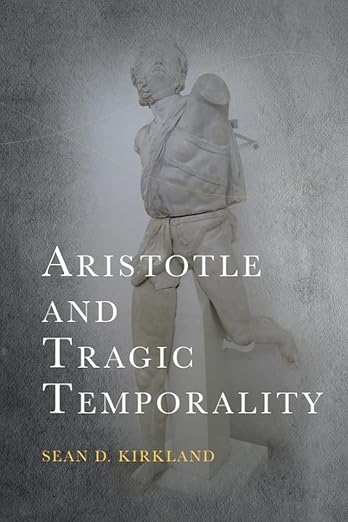
The project of interpretation

In Trump v. Slaughter, the U.S. Supreme Court considered whether the Executive has the right to remove officials of the Executive branch who have been placed there by the Legislature. The case hinged on a reading of the “take care” clause of the Constitution, “The President should take care that the laws are faithfully executed.” Following the unitary executive theory, the majority held that the president has complete authority over the executive. They read this clause to support that theory. But as Jamelle Bouie points out, this clause isn’t a grant of sovereignty. The straightforward plain reading is that it gives the president a fiduciary duty; it obliges the president to enforce the laws passed by Congress. Bouie draws a parallel to the way the current administration reads the 14th Amendment’s clause, “Subject to the jurisdiction of the laws therein” as “an esoteric arcane phrasing that demands additional interpretation,” yet, as Bouie explains, “a plain reader in 1868 or 1869 would have understood it to just mean, you’re subject to the laws, that’s all that means. And there are categories of peoples not subject to the laws.” Historically, this clause referred to the complicated legal and sovereign status of Indigenous tribes. Bouie proceeds to warn, “that conservatives and the conservative legal movement is taking pretty straightforward ideas and trying to make them seem more esoteric and complicated than they are for the express purpose of undermining them,… making them say the opposite of what they mean and then that is in service of a narrow ideological agenda.”[1]

How do we avoid being the people who are “taking pretty straightforward ideas and trying to make them seem more esoteric and complicated than they are for the express purpose of undermining them, to making them say the opposite of what they mean … in service of a narrow ideological agenda”? How do we avoid implying this approach is what is involved in reading historical texts? That is to say, is there a difference between the current SCOTUS’ reading of the “take care” clause and the equal protections clause and Kirkland’s reading of Aristotle’s Poetics?

Bouie describes the straightforward relevant reading as the one that would occur to the contemporary audience of the text. Kirkland invites us to consider how straightforward readings have become sedimented as straightforward by the confrontation of Aristotelian texts with modern philosophy’s investment in a division between the subject and the object. The conceptual frame of a knowing being divided from the world she seeks to engage first and foremost by knowing structures our view of what any thinker is doing in engaging the world. Instead of making Aristotle more esoteric then, Kirkland’s reading suggests that modernity has conflated Aristotle with Descartes as the current SCOTUS has conflated Project 2025 with the US constitution. Following Kirkland, we should take modernity’s reading of Aristotle and SCOTUS’ reading of the U.S. Constitution as the contrived and esoteric ones.

(Aashish Kiphayet via Shutterstock)
Read more

‘You Can’t Legislate Morality’: On Punishing Adults to Change Their (legally permissible) Behaviors

I’ve watched a couple episodes of Leah Remini’s exposé of Scientology that has been airing on A&E.  In the first episode, Remini interviews a woman is encouraged to cut herself off from her daughter who has left the Church of Scientology and has become a vocal critic of it.  Remini explains this process of “In Scientology you are also led to believe by disconnecting from your son or daughter or brother or divorcing your husband is because you are helping them to get back in the good graces.  By you saying, “I’m not talking to you,” we’ll straighten you out.  You will come to your senses, and come crawling back to the church to get help.”  I grew up in a church that employed this sort of “church discipline” with the same thinking that the pain of being cut off from people would compel you to change.

These same people would argue against what they called “legislating morality.”  What they mean is, you can’t make people not racist or sexist through the law, and they see laws aimed at protecting people from racism and sexism as actually aimed at changing the privately held views that some people have about others.  By calling it “legislating morality” those on the right make it seems like those laws violate individual rights or privacy in some way.  Those kinds of arguments continue to be made about whether business owners should have to serve customers whose sexuality they think is wrong or provide reproductive healthcare to women.

Through this past campaign season, I began to realize something I’ve personally experienced writ onto a larger scale.  Social conservatives actually want to make the lives of certain people–gay people, trans people, people who have sex without being married–unpleasant, difficult and unhappy following the same logic of Scientologist disconnection or Christian excommunication. Not having healthcare or visitation rights or shared parenting and inheritance rights, not being able to have your driver’s license changed to the right sex, to use public restrooms without harassment, to have your testimony believed by law enforcement will “straighten you out” or make you “come to your senses” about sex and sexuality.  I just want to point out that this approach is akin to parental discipline.  As much as conservatives bemoan the government’s involvement in making society better and call it paternalistic, this approach is more emphatically paternalistic that busing kids to produce desegregation is.  The paternalism that certain people have to have about other people’s lives where they think that by creating difficult conditions in their lives that could only be changed by changing what those certain people find wrong about other people’s lives will actually change those people, discipline them into their view of righteousness, is immense.

The initial concern of those who did not approve of the way they thought morality was being legislated seemed to be that how we think about the world should not be a matter of legislation.  Indeed, while some people think sexism is right and do so with the full protections of the First Amendment, we have decided pretty much that as a community we won’t allow for at least overt sexist policies and practices.  These same religious conservatives who criticize legislating morality want the law to make people’s lives more difficult and painful in order to get them to live otherwise.  This disciplinary strategy–not even in a Foucaultian sense but in a parental sense of disciplinary–aims to use the law to cause people to suffer with the “loving” motivation of getting them to change.  This disciplinary strategy would seem to be a means not only of changing the way that people live but of the way they think about what is good and right, about what they want.

It’s one thing to disagree with people, but another to want to discipline them into agreeing with your view of how they should live by making them miserable.

“It’s the Thought that Counts”: Part II, Truth, its Consequences and the Good

Since I last posted on the question of whether what we think makes us good or bad people, my thoughts keep returning to how difficult this question is.  To reiterate, when I say, what we think might make us good or bad people, I don’t mean whether we think about doing what we might  generally acknowledge to be bad things — that you think about how to hurt someone might set you on the path to being a bad person, or that you think hateful thoughts toward someone is likely to make you hurt them, or you think it is good to get ahead by taking advantage of other people.  I think the value of those kinds of thoughts is less controversial.  What I am considering is whether the ways you think about what is–what we call ontological claims–makes you a good or bad person. Read more

It’s the Thought that Counts: Do Our Ideas Make Us Good or Bad People?

When I was growing up in the PCA (one of the conservative evangelical – read: fundamentalist – Presbyterian denominations, stands for Presbyterian Church of America), there was a strong sense that thinking the right things about God and about your position in relationship to God was a critical part of being a Christian.

Read more