Skip to content

Posts from the ‘Ancient Philosophy’ Category

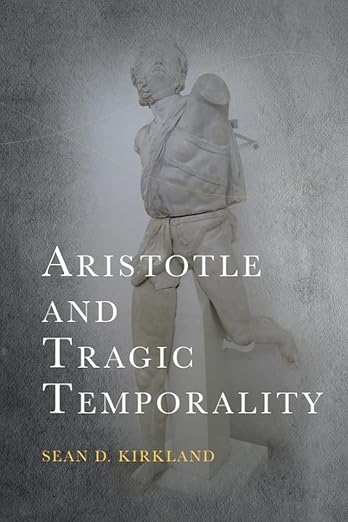
Comment on Aristotle on Tragic Temporality, by Sean D. Kirkland

Presented at the Ancient Philosophy Society, New York City, April 2026

The project of interpretation

In Trump v. Slaughter, the U.S. Supreme Court considered whether the Executive has the right to remove officials of the Executive branch who have been placed there by the Legislature. The case hinged on a reading of the “take care” clause of the Constitution, “The President should take care that the laws are faithfully executed.” Following the unitary executive theory, the majority held that the president has complete authority over the executive. They read this clause to support that theory. But as Jamelle Bouie points out, this clause isn’t a grant of sovereignty. The straightforward plain reading is that it gives the president a fiduciary duty; it obliges the president to enforce the laws passed by Congress. Bouie draws a parallel to the way the current administration reads the 14th Amendment’s clause, “Subject to the jurisdiction of the laws therein” as “an esoteric arcane phrasing that demands additional interpretation,” yet, as Bouie explains, “a plain reader in 1868 or 1869 would have understood it to just mean, you’re subject to the laws, that’s all that means. And there are categories of peoples not subject to the laws.” Historically, this clause referred to the complicated legal and sovereign status of Indigenous tribes. Bouie proceeds to warn, “that conservatives and the conservative legal movement is taking pretty straightforward ideas and trying to make them seem more esoteric and complicated than they are for the express purpose of undermining them,… making them say the opposite of what they mean and then that is in service of a narrow ideological agenda.”[1]

How do we avoid being the people who are “taking pretty straightforward ideas and trying to make them seem more esoteric and complicated than they are for the express purpose of undermining them, to making them say the opposite of what they mean … in service of a narrow ideological agenda”? How do we avoid implying this approach is what is involved in reading historical texts? That is to say, is there a difference between the current SCOTUS’ reading of the “take care” clause and the equal protections clause and Kirkland’s reading of Aristotle’s Poetics?

Bouie describes the straightforward relevant reading as the one that would occur to the contemporary audience of the text. Kirkland invites us to consider how straightforward readings have become sedimented as straightforward by the confrontation of Aristotelian texts with modern philosophy’s investment in a division between the subject and the object. The conceptual frame of a knowing being divided from the world she seeks to engage first and foremost by knowing structures our view of what any thinker is doing in engaging the world. Instead of making Aristotle more esoteric then, Kirkland’s reading suggests that modernity has conflated Aristotle with Descartes as the current SCOTUS has conflated Project 2025 with the US constitution. Following Kirkland, we should take modernity’s reading of Aristotle and SCOTUS’ reading of the U.S. Constitution as the contrived and esoteric ones.

(Aashish Kiphayet via Shutterstock)
Read more

Lectures on Plato’s Republic

First of 20 episodes. Follow Link to YouTube here.

Why Aristotle Today?

Playing with Plato: Teaching with Games

I’m teaching a senior seminar on Plato’s Republic this semester. One skill I have been focusing on all semester is close reading. I have students do several short assignments in which they have to offer close readings of the text. But in our class discussions, conversations tends to become more general and less tethered to specifics of the text. I want students to make their claims rooted in the text and to see that arguments over how to interpret are a key part of the philosophical work in the history of philosophy.

Read more

Plato’s Divided City and the Police

This morning, the family of Breonna Taylor held a news conference in which they expressed their anger and frustration with Kentucky AG Daniel Cameron’s grand jury investigation that ended with charges for only of the officers involved in the shooting of Breonna Taylor. Taylor was shot as the result of a botched drug raid through a no-knock warrant when officers entered the wrong apartment. Taylor’s boyfriend shot thinking that the apartment was being burglarized. One officer involved, Brett Hankison, was charged with three counts of wanton endangerment for bullets that went into another apartment. The facts of the case are not disputed. No drugs were found in Taylor’s apartment.

At the press conference, Bianca Austin, Taylor’s sister, said, “What [Daniel Cameron] helped me realize is that it will always be us against them. That we are never safe.”

Read more

Athlete, Strengthen Thyself! Making the (Running) Body

I am in my tenth week of an intens(iv)e training program to run a half marathon in November. Perhaps running the race is wishful thinking, but the training is keeping me focused during the pandemic. The training is based on Stacy Sims’ book, Roar: How to Match Your Food and Fitness to your Female Physiology for Optimum Performance, Great Health, and a Strong, Lean Body for Life.

Sims’ claim based on her own research as an exercise physiologist and nutrition scientist is that people who have more estrogen and progesterone and other hormones we have traditionally called “female” cannot be trained as small men as they have been for decades. During the high hormone phase of the menstrual cycle for those who menstruate, the body has a harder time taking up protein. If you don’t get significant protein within 30 minutes of a workout, the body recovers by taking protein out of muscles — basically eating the muscles instead of building them. In addition to the different needs brought about by different hormones, the different physiology, specifically for example broad pelvic bones, lead to less stability in the knees and thus more of a likelihood to be knock-kneed — and in running to have less stability and a tendency for knees to collapse in — unless glutes are significantly strengthened. Even really strong women athletes can have strong quadriceps and still buckle their knees when they jump if they aren’t working on building all three gluteus muscles.

Read more

What’s Really Conservative about References to Nature

The first references to nature or physis in Athens* were made by those supporting aristocratic partisans against their perception of a rigid democratic establishment in the 420s BCE. Nomos was considered the embodiment of popular sovereignty.[1] Before physis, “to eon” or just “that which is” or easier “the fact” was opposed to nomos. The sophists chiefly served–for a fee–the aristocratic youth whose parents’ wealth and good birth had ceased to give them the power to which they thought they should be entitled. The distinction the sophists offer between physis and nomos justifies the aristocratic claim against entrenched democratic interests.

Physis was associated with one’s birth, so it allowed the aristocrats to associate their own power with their birth, and thus with physis. The aristocrats thought that by virtue of their birth they had a claim to rule. The sophists give them the language of physis to justify this claim through birth, which points to ways that the reference to physis in its beginnings was in the service of a kind of eugenics, those of better birth were those whose rule was more natural. Nature itself was of those who were better born. To be better born was to be on the side of nature. From that claim, the oligarchic interests take up the sophistic view that physis is just what is against the nomos or convention that changes and is thus without ground–a charge familiar to us as a criticism of democratic approaches to justice from Plato. If those who are better born whose claim to rule is natural, and returning to the ancient customs wherein the well-born ruled, then nature is just what had always been, and the changes wrought by the increasingly democratic regimes were suspect. Nature gets put on the side of “things remaining the same,” and convention on the side of constant change and radical disruptive power of the commoners. The sophists introduce arguments that further put physis on the side of intelligence against wealth. Those who newly make wealth still do not have the intelligence that comes with being well-born.

Read more

Jo Walton’s The Just City

In some ways Walton really captures the sense in which the point of philosophy is to engage in a life of questioning and examining and dialectically following the conversation where it leads. There are insights into Plato and into philosophy to be found here. It isn't a substitute for reading Plato's Republic, but perhaps the novel--like good public philosophy--could be an on-ramp.

Read more

Teaching Aristotle’s Metaphysics as a Five-Act Shakespearian Play

Ryan Johnson contacted me after my posts (here and here) on teaching Aristotle through active teaching exercises to tell me about his own active Aristotle classroom. I think you will share my enthusiasm for his creative approach. This is his account of how he teaches Aristotle’s Metaphysics.

For me, metaphysics is a practice. While theoretical, it is still something you do. If a qualifier is helpful, let’s call it lived metaphysics. I learned this from reading ancient metaphysics, especially Aristotle’s τὰ μετὰ τὰ φυσικά. This sense of metaphysics as a lived practice inspired how I teach Elon  University’s Ancient Philosophy class. The constant theme of our class is: metaphysics is not a rarified, merely theoretical discipline, but is an activity, a practice. Metaphysics is something you really do. The question was how to turn this into a class.

Here are the four main ways I teacher ancient metaphysics as a practice. First, I turned Aristotle’s Metaphysics into a five-act Shakespeare-inspired play and used that to structure the course. Second, I turned Act I, which focuses on the moments in pre-Socratic philosophy that Aristotle discusses in Book I, into a series of experiential learning exercises. I developed these with the always creative and inspiring Rob Leib of Florida Atlantic University. Third, the students’ semester-long writing assignment was to write their own metaphysical treatises, as well as critique each other’s treatises and then re-write their own in response to their peers’ critiques. Fourth, students performed what I call metaphysical ekphrases. Read more

Report on the GLCA Ancient Philosophy Research and Teaching Collaborative Initiative

Crossposted from the Great Lakes College Association Center for Teaching and Learning blog.

The GLCA Ancient Philosophy Research and Teaching Collaborative Initiative began in 2014 when several of us in the GLCA who work in ancient philosophy began a series of conversations about how we might take advantage of the resources we share across the consortium for teaching and writing in ancient philosophy. In particular, we thought that ancient philosophy was a good site from which to think about pedagogy since these ancient thinkers were interested in questions of what it means to learn and to teach. These thinkers take seriously the problem that the person who does not know tends to be unaware of what she does not know, so the learning process becomes a paradox: how does a person enter a learning process if she does not realize that she needs to learn? Realizing one needs to learn at some level involves already knowing that which one needs to learn because to recognize this point suggests you know the knowledge you lack is missing. How can you identify it as missing if you do not know it? If you know that you miss it and therefore in some sense know it, then you don’t need to learn it because you know it. Some in-between space is required which allows the movement from not knowing to recognizing ignorance and fostering a desire to know.

Read more