Skip to content

Posts from the ‘Philosophy’ Category

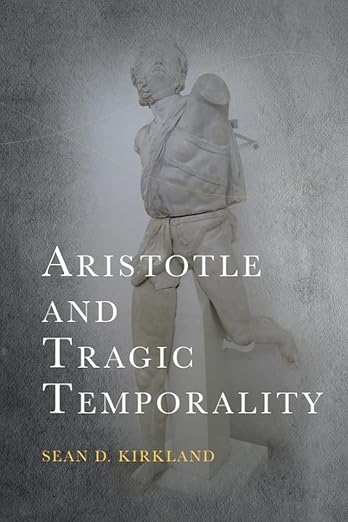
Comment on Aristotle on Tragic Temporality, by Sean D. Kirkland

Presented at the Ancient Philosophy Society, New York City, April 2026

The project of interpretation

In Trump v. Slaughter, the U.S. Supreme Court considered whether the Executive has the right to remove officials of the Executive branch who have been placed there by the Legislature. The case hinged on a reading of the “take care” clause of the Constitution, “The President should take care that the laws are faithfully executed.” Following the unitary executive theory, the majority held that the president has complete authority over the executive. They read this clause to support that theory. But as Jamelle Bouie points out, this clause isn’t a grant of sovereignty. The straightforward plain reading is that it gives the president a fiduciary duty; it obliges the president to enforce the laws passed by Congress. Bouie draws a parallel to the way the current administration reads the 14th Amendment’s clause, “Subject to the jurisdiction of the laws therein” as “an esoteric arcane phrasing that demands additional interpretation,” yet, as Bouie explains, “a plain reader in 1868 or 1869 would have understood it to just mean, you’re subject to the laws, that’s all that means. And there are categories of peoples not subject to the laws.” Historically, this clause referred to the complicated legal and sovereign status of Indigenous tribes. Bouie proceeds to warn, “that conservatives and the conservative legal movement is taking pretty straightforward ideas and trying to make them seem more esoteric and complicated than they are for the express purpose of undermining them,… making them say the opposite of what they mean and then that is in service of a narrow ideological agenda.”[1]

How do we avoid being the people who are “taking pretty straightforward ideas and trying to make them seem more esoteric and complicated than they are for the express purpose of undermining them, to making them say the opposite of what they mean … in service of a narrow ideological agenda”? How do we avoid implying this approach is what is involved in reading historical texts? That is to say, is there a difference between the current SCOTUS’ reading of the “take care” clause and the equal protections clause and Kirkland’s reading of Aristotle’s Poetics?

Bouie describes the straightforward relevant reading as the one that would occur to the contemporary audience of the text. Kirkland invites us to consider how straightforward readings have become sedimented as straightforward by the confrontation of Aristotelian texts with modern philosophy’s investment in a division between the subject and the object. The conceptual frame of a knowing being divided from the world she seeks to engage first and foremost by knowing structures our view of what any thinker is doing in engaging the world. Instead of making Aristotle more esoteric then, Kirkland’s reading suggests that modernity has conflated Aristotle with Descartes as the current SCOTUS has conflated Project 2025 with the US constitution. Following Kirkland, we should take modernity’s reading of Aristotle and SCOTUS’ reading of the U.S. Constitution as the contrived and esoteric ones.

(Aashish Kiphayet via Shutterstock)
Read more

Resources and References for Teaching Butler’s Who’s Afraid of Gender?

In the Spring of 2025, I taught Judith Butler’s Who’s Afraid of Gender? As I was teaching it, I compiled links to news articles as well as political and ecclesiastical documents for us to use in considering Butler’s case that gender functions as a phantasm of all of our fears and anxieties regarding climate crisis, the breakdown of the nation-state, the exposure of capitalism’s project of alienation. I share this list in case others would find it useful. There are many more references in the notes, but I think these are the highlights.

Read more

Lectures on Plato’s Republic

First of 20 episodes. Follow Link to YouTube here.

Why Aristotle Today?

Facebook and the Eclipse of Political Solutions

This morning Facebook’s Oversight Board upheld Facebook’s ban on Donald Trump. Yesterday, NPR’s Rachel Martin wondered about how much control social media should have over free speech. With no political efforts to censure Trump, the consequences for his near treasonous speech of January 6 are left to be doled out by private corporations. This situation, I argue, is where the long-developing eclipse of politics in favor of private solutions has led us. If neoliberalism is the marketization of everything, the effort to remove decisions of public concern from public domains into private ones, then the situation in which social media companies have more power over managing the dangerous speech of politicians than the public domain is its logical conclusion.

Even if you are happy with this decision, we should sound the alarms. Not the alarm that Facebook has too much control, though it does. Twitter and Facebook are totally within their rights to ban people from their platforms. They are private companies. That is the problem. Social media is a public utility, and we treat it as such, and then complain that it is run like a private company. But social media companies are private companies. If we want them to be run in such a way that serves the public good, we should nationalize them. Government, not private companies, is constrained by the First Amendment to “make no law…abridging the freedom of speech.” If the main site of speech has become private companies, and it seems that companies have more say of speech than the government, then we should really rethink whether those sites of free speech should be private.

Neoliberalism has sapped us of the desire to insist on political solutions and has led us to think that private corporations need to be made to do the right thing by their $130 million-supported oversight boards, rather than by governmental power driven by political pressure. This is wrong-headed. We should not ask private companies to regulate themselves. We should not find satisfaction in private companies punishing those who public officials lack the political will to punish. We should insist on political reckonings.

Already conservatives are bemoaning that Facebook is interfering in the 2024 election. And indeed, Facebook, along with Twitter, seems like the only organization holding Trump accountable. My point is that our satisfaction with this holding accountable is evidence of how much we have ceded the responsibilities of political life to private corporations. We should not find this satisfactory. Not because it wasn’t the right decision, but because the accountability should be a matter of political reckoning. Let’s not cede that space.

Augustine and the Cruel Theology of Absolving God

Why is Augustine so cruel? His argument for free will rests on absolving God of responsibility for evil in the world, ultimately for the suffering of evil that is occurring around him, and to make the case, Augustine again and again notes that God punishes but God punishes justly and so God cannot be responsible for the suffering caused.

I have taught Augustine’s On the Free Choice of the Will so many many times. I used to teach it in every introductory course because it was such a fitting transition between ancient thinking and modern thinking. It stages Descartes’ Meditations nicely since many of his arguments can be found in inchoate form in Augustine, and it shows precisely that to which Nietzsche is responding in On the Genealogy of Morals. I’m teaching it now in a course on medieval philosophy. It’s been some time since I taught it. In the meantime, I’ve encountered alternative possible readings of the sacred texts upon which Christianity is based in the work of people like Ted Jennings who makes the case that Christianity offers a political philosophy of exposing the injustice of empire by exposing the cruelty at the heart of its efforts at law and order (Transforming Atonement, 221). Adam Kotsko similarly makes a case in The Prince of Darkness for the genealogy of the devil who went from being associated with empire by those who were oppressed to being associated with the rabble-rousers once Christianity becomes the empire. When this happens, as Jennings shows, God is supposed to be on the side of systems of domination and division, “the one who condemns and afflicts with suffering and death” (21).

Read more

How Ideas Circulate. Online. In Philosophy: Remarks and Suggestions for the APA Blog Session

The important thing here, I believe, is that truth isn’t outside power, or lacking in power: contrary to a myth whose history and functions would repay further study, truth isn’t the reward of free spirits, the child of protracted solitude, nor the privilege of those who have succeeded in liberating themselves. Truth is a thing of this world: it is produced only by virtue of multiple forms of constraint. And it induces regular effects of power. Each society has its régime of truth, its ‘general polities’ of truth: that is, the types of discourse which it accepts and makes function as true; the mechanisms and instances which enable one to distinguish true and false statements, the means by which each is sanctioned; the techniques and procedures accorded value in the acquisition of truth; the status of those who are charged with saying what counts as true. –Foucault, “Truth and Power,” in Power / Knowledge, 131

Any conversation about the circulation of ideas online has to understand the material power at work in how ideas circulate, whose ideas circulate without obstacles and whose ideas encounter obstacles. Moreover, this conversation has to recognize that the circulation of ideas involves material questions about who holds what positions where and who is able to set the agenda for what areas of philosophy should be covered in departments and who should be considered worthy for filling those lines, who should be read, who should be cited, who should be appointed editor of prestigious journals, which journals should be considered prestigious, and so on.

A little more than five years ago there was a robust conversation online about how the philosoblogosphere had influenced the material circumstances of what is considered good philosophy in the United States. Ben Alpers the historian of ideas gathers some of the reflections on the sociology of philosophy, concentrating on the way that online voices and rankings amplified particular views of what philosophy is in a way that influenced what kind of philosophy was considered more or less rigorous. In particular, I’m thinking about how continental philosophy programs were excluded from early rankings and how those rankings centered analytic philosophy and analytic approaches to the history of philosophy, but also the way that feminist philosophies and post-colonial philosophies and critical philosophies of race were sidelined.

Read more

Playing with Plato: Teaching with Games

I’m teaching a senior seminar on Plato’s Republic this semester. One skill I have been focusing on all semester is close reading. I have students do several short assignments in which they have to offer close readings of the text. But in our class discussions, conversations tends to become more general and less tethered to specifics of the text. I want students to make their claims rooted in the text and to see that arguments over how to interpret are a key part of the philosophical work in the history of philosophy.

Read more

Plato’s Divided City and the Police

This morning, the family of Breonna Taylor held a news conference in which they expressed their anger and frustration with Kentucky AG Daniel Cameron’s grand jury investigation that ended with charges for only of the officers involved in the shooting of Breonna Taylor. Taylor was shot as the result of a botched drug raid through a no-knock warrant when officers entered the wrong apartment. Taylor’s boyfriend shot thinking that the apartment was being burglarized. One officer involved, Brett Hankison, was charged with three counts of wanton endangerment for bullets that went into another apartment. The facts of the case are not disputed. No drugs were found in Taylor’s apartment.

At the press conference, Bianca Austin, Taylor’s sister, said, “What [Daniel Cameron] helped me realize is that it will always be us against them. That we are never safe.”

Read more

Athlete, Strengthen Thyself! Making the (Running) Body

I am in my tenth week of an intens(iv)e training program to run a half marathon in November. Perhaps running the race is wishful thinking, but the training is keeping me focused during the pandemic. The training is based on Stacy Sims’ book, Roar: How to Match Your Food and Fitness to your Female Physiology for Optimum Performance, Great Health, and a Strong, Lean Body for Life.

Sims’ claim based on her own research as an exercise physiologist and nutrition scientist is that people who have more estrogen and progesterone and other hormones we have traditionally called “female” cannot be trained as small men as they have been for decades. During the high hormone phase of the menstrual cycle for those who menstruate, the body has a harder time taking up protein. If you don’t get significant protein within 30 minutes of a workout, the body recovers by taking protein out of muscles — basically eating the muscles instead of building them. In addition to the different needs brought about by different hormones, the different physiology, specifically for example broad pelvic bones, lead to less stability in the knees and thus more of a likelihood to be knock-kneed — and in running to have less stability and a tendency for knees to collapse in — unless glutes are significantly strengthened. Even really strong women athletes can have strong quadriceps and still buckle their knees when they jump if they aren’t working on building all three gluteus muscles.

Read more