Skip to content

PODNetwork Conference 2015: Critical Reflection

Image from PODNetwork, logo for 2015 conference.

Just left my first PODnetwork meeting in San Francisco.  POD is the acronym for Professional Organizational Development, which, I know, sounds like something I’d never be a part of.  But the meeting was about pedagogy, which I am very much a part of.  I’m a faculty member who does not have an official role in a Center for Teaching and Learning, but I am the program chair of the Gender Studies minor; I administer a GLCA grant on Ancient Philosophy Teaching and Research where one component is a pedagogy workshop;  and I’m actively engaged in discussions of pedagogy as many other faculty are on my campus (as part of the academic honesty task force, for example).  All this to say, I was thinking about the discussions at the meeting very much from a faculty perspective. Read more

Teaching Dialogue(s): A Digital Engagement with Plato, Socrates and Chris Long

At HASTAC2015 at Michigan State in May, then-soon-to-be-new Dean of College of Arts and Letters at MSU, Chris Long, and I hatched a plan to have my students engage his book, Socratic and Platonic Political Philosophy (Cambridge 2014).  Students would read the book online and engage the digital platform Cambridge set up to encourage a living relationship to the text. As a follow up and to enhance the dialogical engagement, Long agreed to videoconference into class.  This week, we did it.   Read more

Collected Reviews of Ta-Nehisi Coates’ Between the World and Me

I went looking for reviews of Ta-Nehisi Coates’ book, Between the World and Me, ahead of our last reading group meeting on it. In case you needed evidence that Coates has sparked a national conversation, here it is.  The reviews point up the issues raised by the book: who is this book for?  what kinds of demands do White and Black readers bring to the book and how do those demands point to the very issues Coates raises about the relation between the Dream and the struggle? Read more

A Brief Note on a Teaching Success: Mind your Zeus

Have you ever had that moment when something you’ve been trying to teach for years finally comes together because of one brief moment of pedagogic brilliance?  I find these moments rare.  But I just had one.  I teach ancient Greek philosophy.  One reason I like to teach this course is that it asks that students take seriously the question, why should we do philosophy rather than not?  Ancient Greek thinkers remind us that the question of whether philosophy is worth studying is as old as philosophy itself and not something invented by the neoliberal university.

The difficulty in introducing this question is figuring out where to start.  If you start with Plato, for whom this question is explicit in the Apology and the Republic and pretty much all over the corpus, you get the question pretty clearly, but you ignore the two hundred (at least) years of thinking in the Greek world that precede Plato, thinking which Plato himself explicitly references.  So students walk away thinking Platonic, or at least, Socratic, thinking is the beginning of philosophy.  So I push back and teach the pre-Socratics.  But if you start with the pre-Socratics they seem like the primitive thinkers to Plato or Socrates’ developed thinking.  So for years now, I’ve been trying to start with Hesiod’s Theogony. Read more

Exploring Indiana: Bloomington and Brown County

Last weekend, we slept in the fifteenth bed in six weeks, visited the 27th town at home and abroad in three months.  We drove south from Crawfordsville to Bloomington, Indiana to visit a dear friend and graduate school colleague with whom we also visited Terre Haute, Nazareth Pantaloni.  Naz took us to visit the T.C. Steele State Historic Site in Brown County.  Brown County is today considered the art colony of the midwest, but in the early twentieth century, T.C. Steele was the first artist to make Brown County his home.  Steele was one of the first of the “Hoosier group” of American impressionists.  He had studied in Germany in the style of the Old Masters, but explored the impressionist style of painting first in Indianapolis and then in Brown County (the theme of the urbanites coming to the country and not understanding the rural ways and not being understood by the countryfolk is a recurring one in the docent’s spiel). Read more

Not Being Able to Make What is Just, Strong, One Made what is Strong, Just.

In Pensees, Blaise Pascal writes:

Justice, Force.—It is just that what is just be followed; it is necessary that what is strongest be followed. Justice without force is impotent; force without justice is tyrannical. Justice without force is contradicted, because there are always bad people; force without justice stands accused. So justice and force must be put together; and to do so make what is just, strong and what is strong, just. 

Justice is subject to dispute; force is easy to recognize and is indisputable.  And so one could not give force to justice, because force contradicted justice, and said that it is was unjust, and said that it was force that was just. And thus, not being able to make what is just, strong, one made what is strong, just.

The week that Sandra Bland died in police custody, I was working through this passage that Derrida quotes in The Beast and the Sovereign with friends, colleagues and students in Italy.  Today, two days after another young black man was shot in Ferguson, MO, I have been recalling this passage.  Pascal recognizes our problem: we need justice to have force, but if all we have is force, there will be no justice.  What is the just way of giving force to justice? Read more

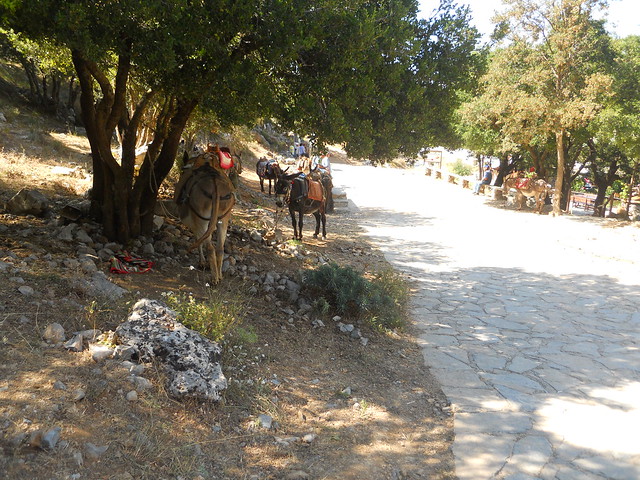
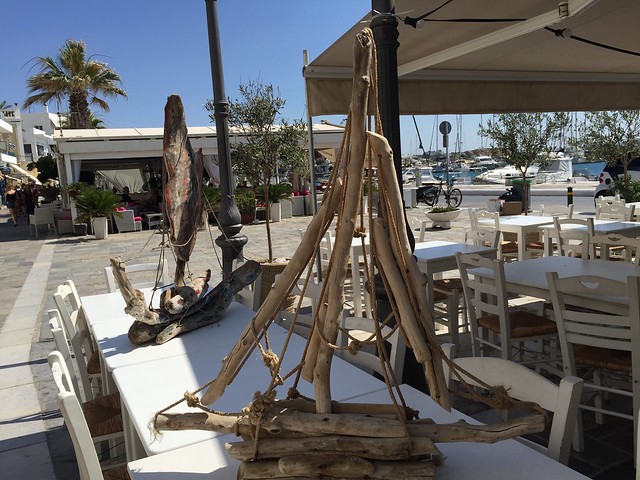
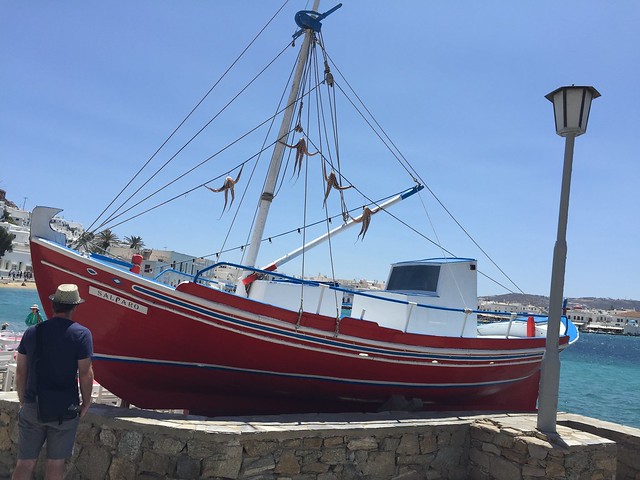
Photographic Records of Crete, Naxos, Delos and Mykonos

Now that I’ve had some time (three days) back at home before we leave again for another (more mundane) trip, I’m posting pics from Greece.  Enjoy!

Crete

Crete

Naxos

Naxos

Delos

Delos

Mykonos

Mykonos

Crete: Even Ancient History has an Ancient History

First photograph is of the town of Chora, Naxos seen through the ruins of the Apollo temple.

Today we leave Crete, traveling on to the second half of our journey — studying Derrida in Italy.  What has been most impressed upon me during our time in Crete is how much human history precedes what I think of as the beginnings of history.  As someone who teaches and writes about ancient Greek philosophy, I’m often trying to get students to think about how Greek thinkers are in conversation with their context and how we remain in conversation with the Greeks as part of our context.  It’s not just that students don’t understand the thinking of the Greeks without understanding their context, it’s that they don’t think that the Greeks have a rich context.  If we just think the Athenians consider themselves to have sprung out of the ground–to be autochthonous, to come from where they are–and we know of nothing that precedes them, this might seem like a reasonable claim, one we have no cause to be suspicious of, just like Americans assuming that we have more claim to be here, we have who have been here for ten generations, than those who are just arriving if we know nothing of the history of what preceded our ancestors ten to fifteen generations ago. Read more

Five Easy Steps to being an Agent of Imperialism

Agent of Imperialism, noun: carrier of empire.  An agent of imperialism is one who imports the reigning hegemonic values wherever she goes.  She assumes that those at the borders of empire desire the empire and are pleased to see it arrive.

1.  Shop at Starbucks, Ben & Jerry’s, the Gap, only at places you could have shopped at the mall at home.  Also, complain about the lack of malls.

2.  Use your credit card instead of cash especially in cash-strapped countries.  If they ask for cash, demand that they take your credit card.

3.  Speak English.  Don’t even ask if the person to whom you speak speaks English before you begin speaking.  Assume everyone does.  Don’t bother to learn simple phrases before you go.  When you return home, continue to demand that everyone visiting or emigrating speak English.

4.  If people do things differently than you do at home, like charge you for the bread they bring to the table even if you didn’t order it or charge you a nominal table fee, insist that your way is the right way.  It’s patriotic.

5.  Mention suing people for things you don’t like–tiny streets with fast cars, cobblestones, not being able to get into your room when you arrive at the hotel, whatever you can think of.

Good luck and enjoy taking the empire to the world!  America thanks you.

Delos: Island of Islands OR More Beasts and Sovereigns

This picture is what erupted into view at the crest of the mountain on Delos that had previously hid itself entirely from view.

In his book, SojournsHeidegger journals his travels through Italy and Greece and the Greek islands.  I have something of a love-hate relationship with Heidegger.  I couldn’t think the way I do nor read ancient texts as I do without the influence of Heidegger.  And yet, when he writes things like: “The Asiatic element once brought to the Greeks a dark fire, a flame for their poetry and thought to reorder with light and measure,” I want to scream.  Heidegger holds a common prejudice that I tease my students for adopting so easily: the East is exotic, full of fire and passion and the West brings order and logic.  When I read that line, I was put in mind of Foucault’s discussion of the Chinese encyclopedia in the Introduction to The Order of Things.   Read more