Skip to content

Posts from the ‘Ancient Philosophy’ Category

Teaching Dialogue(s): A Digital Engagement with Plato, Socrates and Chris Long

At HASTAC2015 at Michigan State in May, then-soon-to-be-new Dean of College of Arts and Letters at MSU, Chris Long, and I hatched a plan to have my students engage his book, Socratic and Platonic Political Philosophy (Cambridge 2014).  Students would read the book online and engage the digital platform Cambridge set up to encourage a living relationship to the text. As a follow up and to enhance the dialogical engagement, Long agreed to videoconference into class.  This week, we did it.   Read more

A Brief Note on a Teaching Success: Mind your Zeus

Have you ever had that moment when something you’ve been trying to teach for years finally comes together because of one brief moment of pedagogic brilliance?  I find these moments rare.  But I just had one.  I teach ancient Greek philosophy.  One reason I like to teach this course is that it asks that students take seriously the question, why should we do philosophy rather than not?  Ancient Greek thinkers remind us that the question of whether philosophy is worth studying is as old as philosophy itself and not something invented by the neoliberal university.

The difficulty in introducing this question is figuring out where to start.  If you start with Plato, for whom this question is explicit in the Apology and the Republic and pretty much all over the corpus, you get the question pretty clearly, but you ignore the two hundred (at least) years of thinking in the Greek world that precede Plato, thinking which Plato himself explicitly references.  So students walk away thinking Platonic, or at least, Socratic, thinking is the beginning of philosophy.  So I push back and teach the pre-Socratics.  But if you start with the pre-Socratics they seem like the primitive thinkers to Plato or Socrates’ developed thinking.  So for years now, I’ve been trying to start with Hesiod’s Theogony. Read more

Crete: Even Ancient History has an Ancient History

First photograph is of the town of Chora, Naxos seen through the ruins of the Apollo temple.

Today we leave Crete, traveling on to the second half of our journey — studying Derrida in Italy.  What has been most impressed upon me during our time in Crete is how much human history precedes what I think of as the beginnings of history.  As someone who teaches and writes about ancient Greek philosophy, I’m often trying to get students to think about how Greek thinkers are in conversation with their context and how we remain in conversation with the Greeks as part of our context.  It’s not just that students don’t understand the thinking of the Greeks without understanding their context, it’s that they don’t think that the Greeks have a rich context.  If we just think the Athenians consider themselves to have sprung out of the ground–to be autochthonous, to come from where they are–and we know of nothing that precedes them, this might seem like a reasonable claim, one we have no cause to be suspicious of, just like Americans assuming that we have more claim to be here, we have who have been here for ten generations, than those who are just arriving if we know nothing of the history of what preceded our ancestors ten to fifteen generations ago. Read more

Book Panel at Antioch College TODAY

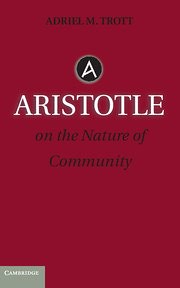
As part of the GLCA Ancient Philosophy Collaborative Initiative, I and my collaborators Lewis Trelawny-Cassity and Kevin Miles will be discussing my book Aristotle and the Nature of Community tomorrow, April 17, 2015, at Antioch College, MacGregor 149 at 4 PM.  This panel will be convened in conjunction with the philosophy roundtable that meets regularly in Yellow Springs.  I’m posting my comments below:

It’s an honor to be given this time and this venue to discuss my research.  I’m grateful to Lewis Meeks Trelawny-Cassity and to Kevin Miles for the time and the consideration they have given my book.  Kevin Miles was the first person with whom I read the Politics.  Since reading Plato and Aristotle with him as a graduate student, I have found a persisting tension between the project of elucidating the question of a text and offering a sympathetic account of it.  My own interest in developing a positive account of Aristotle’s Politics might seem to repress rather than illuminate the questions of the text.  My drive has been to give the strongest reading in an effort to find an alternative to modern conceptions of political life.  I hope that today and not only today, I can try to get clearer about the questions this reading forces upon us. Read more

One Sex, Two Sex, Aristotelian Sex: APS’15 talk

I have of late found myself turning to Aristotle’s biological works to think more carefully about Aristotle’s conception of nature, because I think it is there that the strongest challenge to my reading of physis as the internal principle by which things move from within themselves to fulfill themselves is found.

In the biology, the male semen seems to impose its form on the female menses, suggesting that at the microcosmic level of natural generation, form is imposed on material, external principles master what needs forming.  But as I investigate Aristotle’s biology, I have come to learn that material in Aristotle might not be what we’ve thought it was.

On Saturday, April 11, 2015 at 11 AM at the Ancient Philosophy Society meeting at the University of Kentucky in Lexington, I am presenting a paper (part of my current book project) that focuses on the strange and evasive role of vital heat in Aristotle’s biology.  I argue that the complexities of vital heat might tell us something about whether Aristotle has a one-sex or two-sex model of sexual difference and that his model might also recast our understanding of Aristotelian material. Read more

Treading on Ourselves? Government in Aristotle and Contemporary Political Life

Since Rousseau expressed his concern that government, established to carry out the general will of the people, might become a separate body with its own distinct general will, members of the polity have worried from one end of the political spectrum to the other, that government is imposing its will on the people, rather than executing the people’s will.  It’s not even correct to date this concern to Rousseau, since we could argue that such a concern is encapsulated in Thrasymachus’ realpolitik definition of justice — we all know, let’s be honest Socrates, that the laws serve the powerful and not those who are supposed to follow them.  In these cases, government is understood to be against us, treading on us with its laws and impositions, limiting our freedom rather than protecting it.

Government and Constitution in Aristotle

Eric Schwitzgebel refers to Aristotle to talk about blameworthiness for implicit biases in his talk at the Pacific APA next week.  I’m pleased to join in the appeal to Aristotle to think about contemporary political and ethical problems.  My argument is that Aristotle addresses this problem of thinking the government as an imposition by arguing for an account that drives politeuma, or government, closer to an identity with the politeia, constitution or regime.   Read more

“Divergent” Subjects: The Individual Against the Collective

Last weekend, I finally watched Divergent.  Last semester, I kept telling students in my Plato’s Republic seminar that someone needed to get on the film version of the dialogue.  It just seems so cinematically rich.  I mean, I know people have made films that are treatments of the cave analogy, but I want the thriller that is the dialogue as a whole.

Halfway through the semester a student told me I needed to see Divergent because it depicted Plato’s Republic.  Let’s just bracket that this film fails as a depiction because any successful film of the dialogue would have to find a way to perform the narrative encapsulation of the dialogue–Socrates narrating the story of the conversation that follows, the argumentative set up to the city in light of the question of whether justice is advantageous.  If Divergent depicts the Republic, it does so because it depicts a community in which people are divided into classes on the basis of their natures and these classes do the different tasks needed for the city to flourish.  Erudite seeks knowledge, Dauntless defends the city, Amity farm peacefully at the outskirts of the city, Candor speaks the truth, and Abnegation feed the poor and rule the city.  The film, which is based on the novel of the same name by Veronica Roth, gets traction from the problem that not everyone easily fits into one category, because you know, they’re divergent!  Like Hunger Games, a story that sets itself up as a revolutionary tale of resistance against oppression, Divergent ends up serving the same neoliberal practically Ayn-Randian celebration of individualism against collective action.  In this film, the collective becomes a problem because it attempts to limit and narrowly define individuals, while individuals succeed only when they work independently of the collective in order to resist it. Read more

The Arab-Islamic Gift: Translating Western Culture OR Thanks for the Roots of Western Culture, Savages, Now Scram.

About twelve different things converged this week to make me excited about thinking about the Arabic and Islamic contribution to Greek translation history.  Obama gave a speech at the National Prayer Breakfast referencing “terrible deeds in the name of Christ” to which critics responded that that wasn’t representative of Christianity and that it ignores how the Crusades were provoked by Muslims, never mind that claims that violence done in the name of Allah is not representative of Islam are roundly dismissed or that it isn’t so obvious that Christianity created liberalism.  Chris Kyle, the hero of American Sniper, regularly refers to the Iraqis he is killing at a sniper’s distance as savages in that film that has spawned a whole new round of people eager to do violence to Muslims.  The standoff between Europe and Greece over debt is currently being negotiated raising questions of what Greece’s relationship to Europe is.  I just wrote the course description for my medieval philosophy course next semester that will take up Christian, Jewish and Islamic commentators of Aristotle. I’ve been re-reading The Autobiography of Malcolm X for a reading group I’m doing on campus for Black History Month with some other faculty and students and I was just yesterday reading the middle chapters about the Nation of Islam and Malcolm X’s efforts to recast the history of race relations and religion. I’ve been teaching about how social context affects perception in my philosophy of race course. Into this constellation of thoughts and events landed an essay by Azzedine Haddour from the 2008 edited collection Translation and the Classic: Identity as Change in the History of Culture.  Haddour’s essay, “Tradition, Translation and Colonization: The Graeco-Arabic Translation Movement and Deconstructing the Classics,” returned my attention to some themes I was thinking of last summer in terms of the question of ‘ownership’ of the Greeks (which I blogged about here and here).  Haddour argues that the Arabic role in the transmission of Greek texts to us, and through Greek texts, Western culture, is effaced when it is considered merely passive, as a conduit that moves what is “ours” through “them” to get it safely back to” us.”  Not only was it not passive, Haddour argues, but Arabic culture brought us many of the knowledge practices that we today think of as quintessentially “Western” and Christian: the inquisitive spirit and the primacy of the text.  If he’s right, we have Arabic Islam to thank for the tradition of  textual criticism.

Read more

Friendship, Part II: Aristotle and Romantic Friendship

Cross-posted from Genetic Method.

In my last post on friendship, I responded to my friend Ashley Vaught’s questions about the role of proximity in friendship in Aristotle.  I  consider some questions there about whether virtue friendship is possible when we are still on the way to becoming completely virtuous.  I was left wondering how we can ever become virtuous if we need friends to become virtuous but we can’t be virtue friends before we are completely virtuous.  Perhaps it isn’t just that friendship is impossible, but rather that our friends who help us become virtuous must be more virtuous than we are.  One possibility is that virtue in Aristotle unlike in Plato can be partial and always underway since virtue is practiced and requires a practice of ethical perception which is then limited based on our individual habits of seeing.  Against the view that friends become virtuous and then become capable of having complete and virtuous friendships with us, I think that Aristotelian virtue friends make us have more complete virtue because together we can see better, ethically speaking.  It is not lost on me that my exchange with Ashley over friendship in Aristotle illustrates how friends help us see more and better.  I appreciate the meta-ness of that more and better being about how friends help us see more and better.

Read more

Friendship, Part I: My friends, there are no friends.

Cross-posted from guest blogging appearance at Genetic Method.

My friend Ashley Vaught sent me a long inquisitive email about teaching Aristotle on friendship. Let me just say to start that I really don’t like thinking about, writing about or teaching Aristotle on friendship. When I teach the Nicomachean Ethics, I rarely teach the friendship bits. I have always wondered what the philosophical point was. And as someone interested in how political life is foundational for Aristotle, I have bristled at readings that maintain that Aristotle’s account of friendship implies a pre-political ethical life. Moreover, I’ve never understood what the purpose of this account was except just explaining more about friendship. And what is the point of that? Do people read this and start pursuing more complete friendship? I can just picture someone sitting down and graphing her friendships to judge which friendships are complete and which are for pleasure and which utilitarian, I don’t know, to keep things organized? I don’t think it makes me a bad friend to not enjoy theorizing about friendship. But I do think good friends respond to their friend’s serious inquiries, so when I got a long email from Ashley about friendship in Aristotle, I agreed to have some thoughts. Read more