Skip to content

Posts from the ‘Ancient Philosophy’ Category

Friendship, Part I: My friends, there are no friends.

Cross-posted from guest blogging appearance at Genetic Method.

My friend Ashley Vaught sent me a long inquisitive email about teaching Aristotle on friendship. Let me just say to start that I really don’t like thinking about, writing about or teaching Aristotle on friendship. When I teach the Nicomachean Ethics, I rarely teach the friendship bits. I have always wondered what the philosophical point was. And as someone interested in how political life is foundational for Aristotle, I have bristled at readings that maintain that Aristotle’s account of friendship implies a pre-political ethical life. Moreover, I’ve never understood what the purpose of this account was except just explaining more about friendship. And what is the point of that? Do people read this and start pursuing more complete friendship? I can just picture someone sitting down and graphing her friendships to judge which friendships are complete and which are for pleasure and which utilitarian, I don’t know, to keep things organized? I don’t think it makes me a bad friend to not enjoy theorizing about friendship. But I do think good friends respond to their friend’s serious inquiries, so when I got a long email from Ashley about friendship in Aristotle, I agreed to have some thoughts. Read more

GLCA Ancient Philosophy Workshop Storify

On November 20, 2014, we held Ancient Philosophy Workshop 2014, sponsored by the Great Lakes Colleges Association.  Students from Earlham College, Antioch College and Wabash College presented papers and students and faculty responded.  We were thrilled to have Dr. Jacob Howland, McFarlin Professor of Philosophy at University of Tulsa, speak on “City of Pigs, City of Men: Divine Measure in The Republic’s ‘True’ and ‘Healthy’ City.”

View the Storify of the event #GLCAnct14 here.

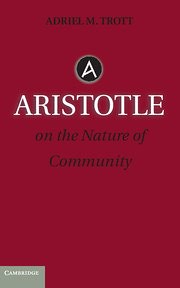
Aristotle on the Nature of Community reviewed at Bryn Mawr Classical Review

Lee Trepanier reviews my book at the Bryn Mawr Classical Review 2014.11.18

Adriel M. Trott’s Aristotle on the Nature of the Community examines Aristotle’s Politics by placing his understanding of nature (physis) at the center of political life. According to Trott, the human being and the polis operate according to natural ends which allow both entities to fulfill their nature, although the political ends of both the citizen and the polis will always remain incomplete as citizens will continually deliberate among themselves over the political community’s goals. By reclaiming nature at the center of political life, the book makes a substantial contribution to our understanding of Aristotle’s political thought and how it could be applicable to contemporary political questions of citizenship, democracy, and community.

Read More

Trott Earns GLCA Grant

The Wabash News announces the GLCA grant I won with some colleagues in Indiana and the GLCA to collaborate on research and teaching projects in ancient philosophy.


The Gods Must be Crazy and So is Nature

I asked my students to write a paper explaining how Zeus in Hesiod’s Theogony is a model of what a standard for nature is, what such a standard reveals about Hesiod’s view of nature or “the way things are”, and what is difficult about establishing a standard for how things are. I decided I would do this assignment, too, to give them a sense of what I am looking for and for an opportunity to continue blogging about Greek mythology. Read more

On Thomas Pangle’s New Book: Reading as Eristic

I read Thomas Pangle’s new book, Aristotle’s Teaching in the Politics (University of Chicago Press, 2013), with both great interest and suspicion.  With great interest because with Pangle, I think the Politics needs to be read creatively and imaginatively–an approach which many people seem willing to use in reading Plato but much more reticent to employ in reading Aristotle.  With suspicion because I realized early on in the monograph that Pangle was a Straussian, someone who thinks there are two levels of writing and reading at work–one wherein Aristotle speaks to the common reader and one wherein Aristotle writes for what Pangle calls “the morally serious reader.”  This kind of bifurcation of the world of thinkers and readers worries me for philosophical and political readings.  I began writing this post with the effort to criticize that reading strategy, and I finished realizing that Pangle’s reading of Aristotle was highly provocative, but it didn’t need the Straussian reading approach to get there.  Resorting to that approach explained some difficulties, but also testified to Aristotle’s explicit effort to take into account many varied and competing positions on the meaning of the political and the role of the philosophical. Read more

Neapoli, Pt. II: Local Guides, Byzantine Towns, and the Southernmost Point in Europe

In my last post I was singing the praises of the local host and guide over a guidebook.  Fittingly, I suppose, I spent the rest of the day working on the debate Aristotle stages in the Politics between those who support the rule of law and those who would advocate the rule of human beings.   Read more

Mycenae: Sites, Stories and Political Structures

One thing that is becoming clear by visiting ruins and archaeological sites in Greece is that the ancient Greeks thought a lot about how what they were going to build fit into the landscape.  I talked about that in my first Delphi post, and it was even more striking to me at Mycenae, where the citadel that holds the palace is set between Mt. Aghios Ilias and Mt. Zara.  This first picture is the view from the top of the citadel of the valley below which stretches to the Gulf of Nafplion.  When you visit, you can see why the Mycenaeans would have chosen this location: from the front, they have a view that stretches over the entire area so they could say any potential invaders from afar, and the back of the citadel is set into the crags of rock that line the lower parts of the mountains that make the citadel almost impossible to scale. Read more

Delphi, Pt. II: More on Socrates and the Gods OR Neither Revealing or Concealing, but Speaking in Signs.

Famous men have the whole earth as their memorial.

The title of this post comes from Pericles’ Funeral Oration as recounted by Thucydides in History of the Peloponnesian War.  My very patient traveling companion read it aloud to me today in the Kerameikos District, the Classical-era cemetery where Pericles gave that oration after the first dead had been returned to Athens at the start of the Peloponnesian War. Thucydides remembers Pericles speaking thus: They [the dead] gave their lives to her [Athens] and to all of us, and for their own selves they won praises that never grow old, the most splendid of sepulchres–not the sepulchre in which their bodies are laid, but where their glory remains eternal in men’s minds, always there on the right occasion to stir others to speech or action. Read more