No One Truly Knows His Own Begetting: Nolan’s Odyssey

οὐ γάρ πώ τις ἑὸν γόνον αὐτὸς ἀνέγνω. No one truly knows his own begetting. – Homer, The Odyssey I.215
I begin my last book with this epigraph, which Telemachus says toward the beginning of Homer’s Odyssey. Telemachus speaks of the difficulty of knowing his father. The line also speaks to the themes of the epic of returning to one’s home, of knowing one’s home, of fidelity to one’s own, of the temptations and lures that prevent one from returning home, of home needing constant cultivation and of always threatening to devolve.
To talk about what I take to be the insights of Nolan’s “The Odyssey,” I want to treat it as a movie in its own right. I want to set aside the question of whether it is true to its source material. I realize that is practically impossible to do. So I will weigh in briefly in order to think about the film as its own story.
- I disagree that Nolan leaves out the gods. The gods do show up, as thunder and lightning, as the angry sea, as seducers, as the monstrous source that explains how a father could sacrifice his daughter to make the winds blow. The Greeks invoke the gods to explain why mortals do the unhinged, unpredictable, rash, courageous, wise and foolish things they do.
- I do think that Nolan depicts a more Roman or Anglo-American Odysseus than a Greek one. We fail to appreciate the strangeness of the Greeks and the Romans are much more accessible as they become a template both for Christianity and for American government. Part of that strangeness is that Odysseus is a cunning trickster. The film depicts him as smart. But he is having more fun than being smart. Leaving out the “no one” joke leaves out the sense both of Odysseus’s joy in defeating Polyphemus and of taking credit as he sails off.
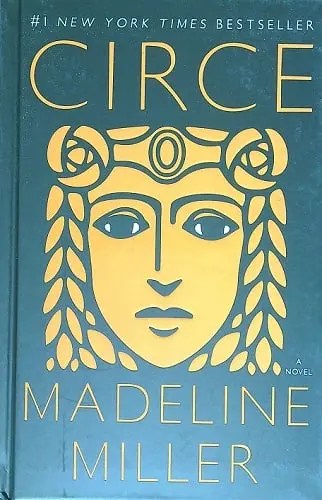
- The Circe scene is a real let down. Madeline Miller does a great job of showing how Circe is a force of nature, able to meet Odysseus wit for wit. Moreover, Odysseus shows up armed by Hermes to ward off Circe with the moly plant, but he nonetheless stays because he is seduced nonetheless. The female characters in the epic have much more character development than Nolan allows.
Back to homecoming. Athena mirrors Telemachus’ line back to Odysseus at the end of the film, “Don’t you recognize your own home?” It is understandable that he does not. Then Odysseus says to Penelope, “It’s not always an easy thing, a homecoming.” I want to speak to two themes: homecoming and guest-welcoming. And I want to speak to how these themes are mirrored and how both speak to a political crisis.
The story is told in large part by Odysseus as he recalls what he has forgotten on the island of Calypso, where he has been for seven years. Away from home, he has forgotten home. He has not only forgotten what home is like, he has forgotten that he has a home. He has forgotten that home has a call to him. One could trace this forgetting to allowing himself to be lashed to the mast to listen to the Sirens’ Song, a song that could be understood as moving cause of Tantallus, that which motivates desire but can never be had. And Odysseus describes the song in that way,
“What you most can’t have is what you already had and lost; the song of all the promises I failed to keep, telling me I don’t really want to go home.”
Nolan made me think that Odysseus doesn’t get the special privilege of listening to the Sirens’ Song and surviving; listening to the Sirens’ Song and surviving is what sets him off course on the road to Calypso. The Sirens’ Song is the lure of what is unreachable and in being unreachable, unreal, the temptation of the apparently exciting turned banal affair, the manifestation of the death drive, the fantasy as such. The Sirens’ Song makes you forget there is a home to return to and then you leap to your death. Leo Strauss in “What is Liberal Education?” reminds us that the Greek word for vulgarity is apeirokalia, lack of experience in things beautiful. The beautiful allows one to tarry with it and live; the beautiful renders one noble. The Sirens’ Song appeals to those with a lack of experience in things beautiful; it entices without satisfaction. Hearing the song and living, Odysseus enters a space in which time does not pass and he has nowhere to go. Fighting his way back to memory, Odysseus fights his way back to the pull of leadership, responsibility and love, which his travels have rendered him incapable of expressing except violently.
This forgetting is related to the problem of recognition. Telemachus can’t even be sure of his parentage. Athena charges Odysseus with not recognizing his own home. The suitors don’t recognize Odysseus. The old servants do. Penelope is wary of such recognition. The difficulty in recognizing points to the crisis of authority. I argue in my reading of Plato’s cave that the problem with following the one who purports to return from outside the cave to set things aright is that they cannot easily be distinguished from the tyrant who wishes to rule for his own gain, especially by those who have not left the cave and cannot judge the knowledge he purports to have. The crisis of recognition of the philosopher-king, a crisis that implores each of us to consider justice rather than to depend on recognizing the one who knows what is just, is the crisis of the palace-regime in which one rules and must be recognized as the one who rules.
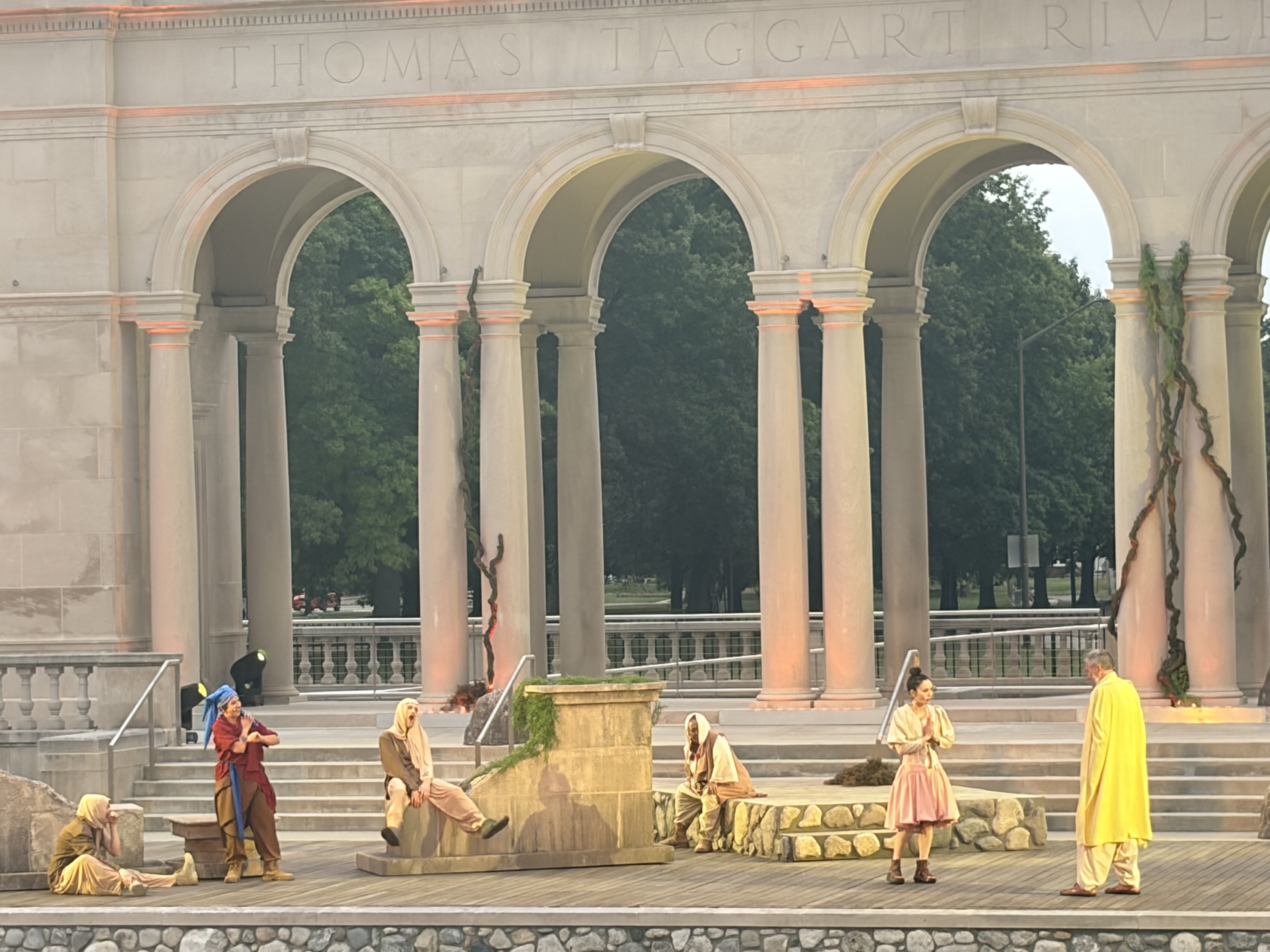
Odysseus has been gone for so long, the order of Ithaca has fundamentally changed. I saw Indianapolis Shakespeare Theater’s King Lear last weekend and was thinking about the crisis of succession and authority between The Odyssey and King Lear. In both, you could say that the king cedes authority too quickly, Odysseus by not racing home, Lear by seeking praise from his children instead of preparing the kingdom for his succession. You could say that in both, the suitors are the source of the downfall. Ithaca is restored, but Odysseus doesn’t waste a moment in sailing off again. As Penelope says, “Our bronze age is collapsing.”
This brings me to the other theme, of hospitality and guest-welcoming. We can’t talk about the recognition crisis and homecoming without talking about the problem of coming home and being welcomed home. The rule of Zeus is to welcome the guest. The guest could be the missing host. Or the guest could be a threat. In my reckoning, there is only one welcoming in the film that goes well and that is Menelaus’ welcoming of Telemachus, and that welcoming shows that Menelaus and Helen recognize Telemachus as the son of Odysseus so he isn’t really a stranger. Consider the other welcomings: the Trojan horse into Troy, the suitors in Ithaca, Agamemnon by Clytemnestra, Iphegenia by Agamemnon, Odysseus by Circe, Odysseus by Calypso, Odysseus’s ships by the sun god, Odysseus’s ships back to sea by Poseidon. In each case, the welcome leads to destruction or delay.
I began to worry that the film was making a xenophobic case about the risks of welcoming the stranger, that it was a diatribe against the rule of Zeus, and that worry is not entirely abated. But here I think we can return to considering the Greek world as one of movement and thus one in which one is likely to be the guest somewhere and thus the expectation that one welcomes the stranger is an expectation that one expects to rely on when he finds himself away from home, which he inevitably will. There are reckonings for those who fail to welcome: Agamemnon could be understood to fail to welcome Iphegenia, luring her on the false promise of a marriage that turns out to be a call to her own sacrifice. But most of the reckonings are for those who overstay or misuse their welcome, including Odysseus, whose men are piggish abroad the way that the suitors are in his home in Ithaca. As Penelope says to Odysseus after worrying about the civilizational collapse marked by the “people of the sea” who do not value the rule of Zeus, “You are the people of the sea.” The rule of Zeus is not just a call to be a good host, but a call to be good guest. A different appeal to the host is made by a beggar than the one made by the hero of the Trojan war, Odysseus, who is not the same as Agamemnon, in thinking he can take whatever war booty he wants, even if it stops a war, but he is in the same sphere. In this way, the treatment of Odysseus allows us to begin to distinguish between the responsibility we have to the migrant and the settler, to the one who is a beggar abroad, one might say, and the one who has state-sanctioned power, the one who needs a home, and the one who attempts to make everywhere he goes home on his own terms.
Telemachus is generally depicted as the weaker, less manly, not ready to be a hero, character. But Telemachus’s understanding that he cannot know his own begetting seems like a warning call. You do not know if you are home. You should not assume you are home. Still, you should probably head home.




I recently learned that Odysseus was suspected for having murdered Palamedes (this from the Aeneid) because the latter showed him to be faking mental illness to avoid the Trojan War.
I haven’t yet seen the film, but I have to say I am doubtful about the casting of Matt Damon. I always thought the character required someone less stalwart, somewhat untrustworthy. That Josh Brolin could do that better …
Emily Wilson is not happy with this film, apparently!
I know Emily Wilson doesn’t like it, but I’m not sure I care. I think there are things to say about the film even if it isn’t Homer. I think the Virgil of it all is certainly lingering in this telling and that is what makes it more Roman than Greek. I don’t think the Odyssey is a revenge plot the way moments in the film might suggest. That said, The Aeneid is fan fiction that is trying to render the Greeks the bad guys as it elevates the Romans as the heirs of Troy so I consider it sus.
Professor Trott,
Several, several years ago, I bought one of your books about Aristotle.
It’s good to see you posting again. I know you had some physical issues and I hope you’re on the mend.
Sincerely
Greg Gray
Thank you! I am doing well! I blogged about the health progress a bit if you are interested you can scroll through the last four or five to get to those posts.