Skip to content

What Makes a Woman? Why Do you Ask?

Last weekend, Elinor Burkett published an opinion editorial in The New York Times calling into question whether Caitlyn Jenner is really a woman.  Sarah Miller points out the many problems with Burkett’s argument over at Jezebel, which I want to point to and double down on here, mostly because I’m put off that even the podcasters over at Slate’s DoubleX had a hard time finding the language to respond eloquently to Burkett.  Noreen Malone notes on the podcast that it was the #1 most emailed piece at NYT over the weekend, which is to say: it struck a chord.  So I want to say a few things about that chord. Read more

#HASTAC2015

I just spent three days at Humanities, Arts Sciences and Technology Alliance and Colaboratory (HASTAC) 2015 conference on the theme: “Art and Science of Digital Humanities.”  I did some livetweeting, which I’ve been doing regularly at conferences but mostly I took notes directly to this post which I then edited to summarize my observations on recurring and important themes from the conference.

Observations

  • This might say more about the kinds of conferences I attend, but this is the most diverse conference community I’ve ever seen.
  • Perhaps not surprisingly for a digital humanities project, it’s also the youngest conference crowd I’ve ever seen. There are many more people in literature and languages using digital humanities in their pedagogy and research than any other field.
  • I participated in recurring discussions of importance and difficulty of interdisciplinarity.  Why do we hyperspecialize?  Why do we entrench?  Funding structures and disputes over resources seem to drive divisions that don’t necessarily serve our ends in digital humanities.
  • A woman whose native tongue was not English kept referring to digital humanity in a panel on using digital resources in medieval studies, which got me thinking is our humanity digital?
  • I had several discussions about ambiguity.  Ambiguity is at the heart of humanities.  Does technology excise the ambiguity in a way that is problematic or can it give students more opportunities to struggle with readings and making their own case for how to read or understand a text?

Read more

New to You Music in 2015: Anaïs Mitchell, Hadestown

I said at the beginning of the year that I’d listen more to new music and write about it. I did that once so far.  I was a little overwhelmed with all the different new things I should be listening to.  Then in the freshmen colloquium course I taught this semester, we had a class session where we read and listened to protest songs–Nina Simone, Billie Holiday, Bob Dylan, Woodie Guthrie, Rage Against the Machine.  We talked about what makes protest songs work as protest songs.  In the next class meeting, students were asked to bring in their favorite protest songs.  To get things started, I offered my own: Anaïs Mitchell’s “Why We Build the Wall.” Read more

What Other People Accomplished By My Age

It’s my birthday.  Here’s some things people accomplished by the time they were my age.  I won’t be coy, I’m 39.

  • By 39, Thomas Jefferson, who studied at my alma mater, had written and signed the Declaration of Independence and become the Governor of Virginia.
  • By 39, G.W.F. Hegel had published his seminal text Phenomenology of Spirit.
  • By 39, Sojourner Truth escaped from slavery, moved to New York and became the first black woman to win a case in court against a white man in the United States.
  • By 39, Elizabeth Cady Stanton had organized and held the Seneca Falls Convention where she, Lucretia Mott and several other women drafted the Declaration of Sentiments proclaiming equality between men and women.
  • By 39, Albert Einstein had published his discoveries of the special and general theories of relativity, which revolutionized modern physics.
  • By 39, Barack Obama had been a community organizer for 12 years and an Illinois Senator for 3.
  • By 39, Hillary Rodham Clinton had served as an advisor on the presidential impeachment inquiry for the Judicial Committee of the House of Representatives during Watergate, had taught at the University of Arkansas School of Law and was the First Lady of Arkansas while working as a partner at the Rose Law Firm.
  •  By 39, Judith Butler had published Gender Trouble and Bodies That Matter revolutionizing the way that we speak about gender and sexuality.
  • By 39, Annie Dillard had published five books including one of my favorites, Pilgrim at Tinker Creek.
  • By 39, my mother had five children.

I leave you these facts without comment.

The painting is “Women VI” by Willem de Kooning whose birthday is today.

Book Panel at Antioch College TODAY

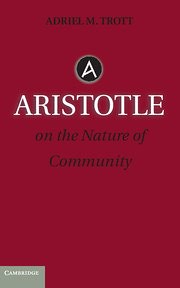
As part of the GLCA Ancient Philosophy Collaborative Initiative, I and my collaborators Lewis Trelawny-Cassity and Kevin Miles will be discussing my book Aristotle and the Nature of Community tomorrow, April 17, 2015, at Antioch College, MacGregor 149 at 4 PM.  This panel will be convened in conjunction with the philosophy roundtable that meets regularly in Yellow Springs.  I’m posting my comments below:

It’s an honor to be given this time and this venue to discuss my research.  I’m grateful to Lewis Meeks Trelawny-Cassity and to Kevin Miles for the time and the consideration they have given my book.  Kevin Miles was the first person with whom I read the Politics.  Since reading Plato and Aristotle with him as a graduate student, I have found a persisting tension between the project of elucidating the question of a text and offering a sympathetic account of it.  My own interest in developing a positive account of Aristotle’s Politics might seem to repress rather than illuminate the questions of the text.  My drive has been to give the strongest reading in an effort to find an alternative to modern conceptions of political life.  I hope that today and not only today, I can try to get clearer about the questions this reading forces upon us. Read more

One Sex, Two Sex, Aristotelian Sex: APS’15 talk

I have of late found myself turning to Aristotle’s biological works to think more carefully about Aristotle’s conception of nature, because I think it is there that the strongest challenge to my reading of physis as the internal principle by which things move from within themselves to fulfill themselves is found.

In the biology, the male semen seems to impose its form on the female menses, suggesting that at the microcosmic level of natural generation, form is imposed on material, external principles master what needs forming.  But as I investigate Aristotle’s biology, I have come to learn that material in Aristotle might not be what we’ve thought it was.

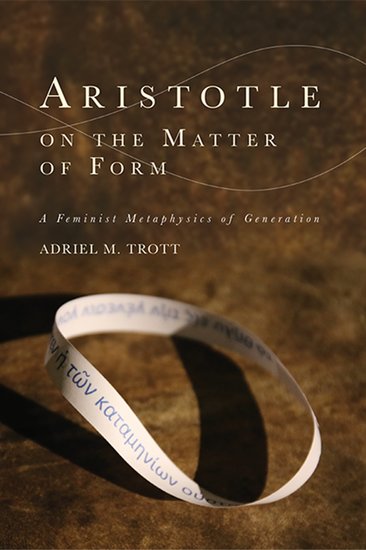
On Saturday, April 11, 2015 at 11 AM at the Ancient Philosophy Society meeting at the University of Kentucky in Lexington, I am presenting a paper (part of my current book project) that focuses on the strange and evasive role of vital heat in Aristotle’s biology.  I argue that the complexities of vital heat might tell us something about whether Aristotle has a one-sex or two-sex model of sexual difference and that his model might also recast our understanding of Aristotelian material. Read more

Beauty as Liberatory on a Morning Run In Vancouver

Let me just recommend first, philosophy conferences in Vancouver; second, starting your conference off with a good night’s sleep and a long run in the beauty of nature.  I ran 11 miles through Stanley Park and then Vancouver this morning where I’m attending the Pacific American Philosophical Assoication (APA).  As I ran, the view changed from the seawall and evergreens to mountains. It was beautiful. It was stunning. I thought of C.S.Lewis’s claim that beauty produces a need to share it with someone else.  I was out there, running through Stanley Park, thinking, this is amazing, do the others not know about this? I need to capture this so they can see it. I kicked myself for not taking my phone with me.

And it was in that moment where I recognized my desire not just to share it, but to capture it that I was brought up short. I was running without any music or podcasts in my ears so I had plenty of time to think this through. It struck me as I continued to run and to think that beauty exceeds apprehension, not just, as we know from Kant, because it exceeds the boundaries of the concept, but also, because it cannot be had.  It cannot be owned. It cannot become a commodity that I can have that shows something good about me on the basis of having seen it. I reached out to grasp this beauty and I could not hold on to it.  I couldn’t master it. But I wanted to. Beauty is liberating because it disrupts the drive to mastery.

Image above does not do justice, give the proper due, to the beauty of my morning. Taken from the balcony of my room.

Treading on Ourselves? Government in Aristotle and Contemporary Political Life

Since Rousseau expressed his concern that government, established to carry out the general will of the people, might become a separate body with its own distinct general will, members of the polity have worried from one end of the political spectrum to the other, that government is imposing its will on the people, rather than executing the people’s will.  It’s not even correct to date this concern to Rousseau, since we could argue that such a concern is encapsulated in Thrasymachus’ realpolitik definition of justice — we all know, let’s be honest Socrates, that the laws serve the powerful and not those who are supposed to follow them.  In these cases, government is understood to be against us, treading on us with its laws and impositions, limiting our freedom rather than protecting it.

Government and Constitution in Aristotle

Eric Schwitzgebel refers to Aristotle to talk about blameworthiness for implicit biases in his talk at the Pacific APA next week.  I’m pleased to join in the appeal to Aristotle to think about contemporary political and ethical problems.  My argument is that Aristotle addresses this problem of thinking the government as an imposition by arguing for an account that drives politeuma, or government, closer to an identity with the politeia, constitution or regime.   Read more

Wendy Brown, Neoliberalism, and Why Taking Your Work Email Off Your Phone Will Not Save Democracy

Neoliberalism: What is it?

I’m currently teaching a course on the Philosophy of Commerce.  I think of this course as an effort to get students to challenge the notion that everything could be economized.  Following Arendt, I’m trying to get students to see what is lost when pursuits of living or living large (when the pursuit of living becomes excessive) crowd out any consideration for living well, which is to say, for organizing and determining how life ought to be in conversation and contestation with others.  This determining how life ought to be is in contrast to just determining what to do in order to live.  This concern has been with us for some time, but in the last several decades a new and even more far-reaching economization of life has occurred, wherein individuals have come to think of themselves as entrepeneurial capital projects.

This development is neoliberalism, which is the subject of Wendy Brown’s new book, Undoing the Demos: Neoliberalism’s Stealth Revolution.  Read more

Performing Philosophy’s Exclusions: The Role of Publicity In Changing the Field

Last week, one of the tone-setting figures in the field of philosophy, University of Chicago law professor Brian Leiter, allowed for some speculation on the reasons for the employment of a nontenured woman philosopher on a thread on his blog (see comment #2 by AnonUntenured).  That thread did not take long to deteriorate into a #MRA meltdown where anonymous trolls insist that it is men not women who are the true victims in the current state of the discipline.  The target of the initial speculation, Leigh Johnson of Christian Brothers University, submitted a comment in reply to the moderated thread where the speculation first arose but it was not approved.  Johnson included that comment in a response which articulated pretty clearly that she is one among many women in philosophy who is just not going to take it anymore.  I witnessed some discussion on social media in light of Johnson’s response where there was disagreement over whether Johnson, and not just Johnson but anyone who was upset that a very senior very influential person was allowing speculation over the legitimacy of a junior woman philosopher’s employment, should bring attention to this behavior by addressing it head on or just ignore it.  I’ve been thinking all week about why I think this kind of thing needs to be publicized rather than ignored.  Her post received 12,000 hits in the first 24 hours it was up in an effort, as she said quoting Gilles Deleuze, “to harm stupidity, to make stupidity shameful.”  I completely support that reasoning for publicizing it, but I want to add another. Read more