Skip to content

Aristotle on Happiness

Aristotle scholars spend a lot of time arguing over whether and in what way a life of action, what is called a ‘practical life’ (from the Greek praxis), which includes a life focused on ethical and political concerns, can possibly achieve happiness, or whether only contemplation — the theoretical life of the philosopher or thinker or scientist — can achieve complete happiness for human beings.  Commenters suppose from several chapters in Nicomachean Ethics X.7 that the case is obviously on the side of contemplation.  Then they fight over how to limit that claim or re-interpret it.

But today, I’ve been prepping those passages to teach and I just don’t think they add up to the obviously strong argument for contemplation against deliberation that pretty much everyone who reads Aristotle seems to think they do.  One argument in particular — that it’s what the gods do — seems just not the case.  What the heck then is Aristotle doing?  Here’s what Aristotle writes:

But that complete happiness is a certain contemplative activity would appear also from this: we have supposed that the gods especially are blessed and happy–but what sort of actions ought we to assign to them?  Just acts?  Or will they appear laughable as they make contracts, return deposits, and do anything else of that sort?  But what about courageous acts?  Do the gods endure frightening things and run risks, because doing so is noble?  Or liberal acts?  But to whom will they give?  And it is strange if they too will have legal currency or something of that sort.  And what would their moderate acts be?  Or is the praise, “they do not have base desires,” a crude one?  All that pertains to actions would appear, to those who go through it, petty and unworthy of gods. (1178b8-17, Bartlett and Collins translation)

Puh-lease, Aristotle.  It seems just as likely from all this that the gods don’t do any of these things because the gods don’t really live virtuous lives.  Do the gods do just acts?  No, Zeus steals women and cheats on Hera on the regular.  The whole of Hesiod’s Theogony seems to be about the frightening risk-taking acts of gods.  But no, not because it’s noble.  They want power, or they’re just bored.  Liberal acts?  Well, basically, that seems to be all of Homer and most of Hesiod where Zeus gives things to gods, and that part where Zeus and Prometheus divide stuff up and give it out.  “And what would be their moderate acts?”  Got me there, Aristotle: we don’t know, because no god has yet to be moderate. Read more

Intellectual Capture

In his book Never Let a Serious Crisis Go to Waste, Philip Mirowski argues that economists were unable to respond adequately to the economic crisis of 2008-2009 because they were subject to “intellectual capture.”  Observers of markets have long complained of “regulatory capture” where those who regulate Wall Street are too cozy with those they regulate and thus held hostage or “captured” by those relationships and so unable to sufficiently regulate their old buddies.  Mirowski argues that many economists were similarly beholden to Wall Street, and unwilling to call foul on the theories that supported the governmental intervention to save Wall Street.

But it isn’t just economists and Wall Street.  The academy, I think the academy in general, but definitely philosophy, suffers a similar intellectual capture.  It works like this.  Junior faculty earn credibility by having senior faculty who vouch for them.  If you are a junior faculty member, you hesitate to call out those who seem to operate in the community of your own protectorate because that is what gives you credibility.  If you need the protectorate to be strong for your position to be strong, you can’t question it.  Especially more vulnerable members of underpresented groups within the community both need the protectorate for others to pay attention to them and are structurally unable to challenge the workings of the protectorate without their own position becoming more vulnerable.   You might not even call out other junior faculty because of fear of their protectorate.  And while justice would seem to demand it, the structure of the academy gives you no incentive to point out the ways your own community is patriarchal and racist, but rather to protect those who perpetuate those practices because it would seem to protect you.  This is one reason we need more women and people of color in the academy.

As academics become more engaged in activism within their institutions and beyond, we need to be thinking about how the structures of activism, in the name of changing the conditions in which we work, repeat them, and repeat them in a way that seems to structurally deny any real critical voice from within regarding how we are repeating them.

PODNetwork Conference 2015: Critical Reflection

Image from PODNetwork, logo for 2015 conference.

Just left my first PODnetwork meeting in San Francisco.  POD is the acronym for Professional Organizational Development, which, I know, sounds like something I’d never be a part of.  But the meeting was about pedagogy, which I am very much a part of.  I’m a faculty member who does not have an official role in a Center for Teaching and Learning, but I am the program chair of the Gender Studies minor; I administer a GLCA grant on Ancient Philosophy Teaching and Research where one component is a pedagogy workshop;  and I’m actively engaged in discussions of pedagogy as many other faculty are on my campus (as part of the academic honesty task force, for example).  All this to say, I was thinking about the discussions at the meeting very much from a faculty perspective. Read more

Teaching Dialogue(s): A Digital Engagement with Plato, Socrates and Chris Long

At HASTAC2015 at Michigan State in May, then-soon-to-be-new Dean of College of Arts and Letters at MSU, Chris Long, and I hatched a plan to have my students engage his book, Socratic and Platonic Political Philosophy (Cambridge 2014).  Students would read the book online and engage the digital platform Cambridge set up to encourage a living relationship to the text. As a follow up and to enhance the dialogical engagement, Long agreed to videoconference into class.  This week, we did it.   Read more

Collected Reviews of Ta-Nehisi Coates’ Between the World and Me

I went looking for reviews of Ta-Nehisi Coates’ book, Between the World and Me, ahead of our last reading group meeting on it. In case you needed evidence that Coates has sparked a national conversation, here it is.  The reviews point up the issues raised by the book: who is this book for?  what kinds of demands do White and Black readers bring to the book and how do those demands point to the very issues Coates raises about the relation between the Dream and the struggle? Read more

A Brief Note on a Teaching Success: Mind your Zeus

Have you ever had that moment when something you’ve been trying to teach for years finally comes together because of one brief moment of pedagogic brilliance?  I find these moments rare.  But I just had one.  I teach ancient Greek philosophy.  One reason I like to teach this course is that it asks that students take seriously the question, why should we do philosophy rather than not?  Ancient Greek thinkers remind us that the question of whether philosophy is worth studying is as old as philosophy itself and not something invented by the neoliberal university.

The difficulty in introducing this question is figuring out where to start.  If you start with Plato, for whom this question is explicit in the Apology and the Republic and pretty much all over the corpus, you get the question pretty clearly, but you ignore the two hundred (at least) years of thinking in the Greek world that precede Plato, thinking which Plato himself explicitly references.  So students walk away thinking Platonic, or at least, Socratic, thinking is the beginning of philosophy.  So I push back and teach the pre-Socratics.  But if you start with the pre-Socratics they seem like the primitive thinkers to Plato or Socrates’ developed thinking.  So for years now, I’ve been trying to start with Hesiod’s Theogony. Read more

Exploring Indiana: Bloomington and Brown County

Last weekend, we slept in the fifteenth bed in six weeks, visited the 27th town at home and abroad in three months.  We drove south from Crawfordsville to Bloomington, Indiana to visit a dear friend and graduate school colleague with whom we also visited Terre Haute, Nazareth Pantaloni.  Naz took us to visit the T.C. Steele State Historic Site in Brown County.  Brown County is today considered the art colony of the midwest, but in the early twentieth century, T.C. Steele was the first artist to make Brown County his home.  Steele was one of the first of the “Hoosier group” of American impressionists.  He had studied in Germany in the style of the Old Masters, but explored the impressionist style of painting first in Indianapolis and then in Brown County (the theme of the urbanites coming to the country and not understanding the rural ways and not being understood by the countryfolk is a recurring one in the docent’s spiel). Read more

Not Being Able to Make What is Just, Strong, One Made what is Strong, Just.

In Pensees, Blaise Pascal writes:

Justice, Force.—It is just that what is just be followed; it is necessary that what is strongest be followed. Justice without force is impotent; force without justice is tyrannical. Justice without force is contradicted, because there are always bad people; force without justice stands accused. So justice and force must be put together; and to do so make what is just, strong and what is strong, just. 

Justice is subject to dispute; force is easy to recognize and is indisputable.  And so one could not give force to justice, because force contradicted justice, and said that it is was unjust, and said that it was force that was just. And thus, not being able to make what is just, strong, one made what is strong, just.

The week that Sandra Bland died in police custody, I was working through this passage that Derrida quotes in The Beast and the Sovereign with friends, colleagues and students in Italy.  Today, two days after another young black man was shot in Ferguson, MO, I have been recalling this passage.  Pascal recognizes our problem: we need justice to have force, but if all we have is force, there will be no justice.  What is the just way of giving force to justice? Read more

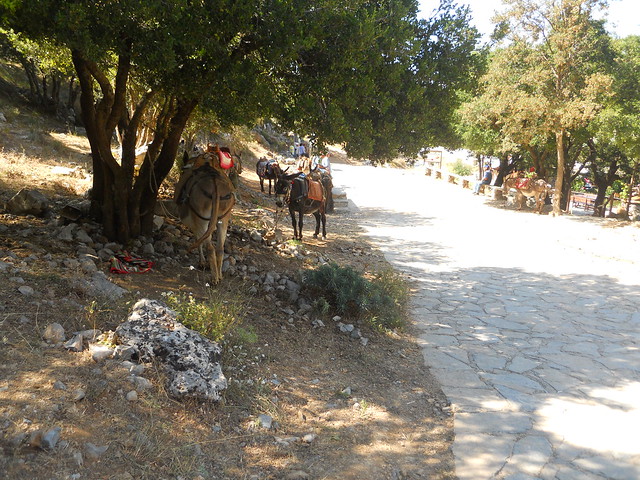
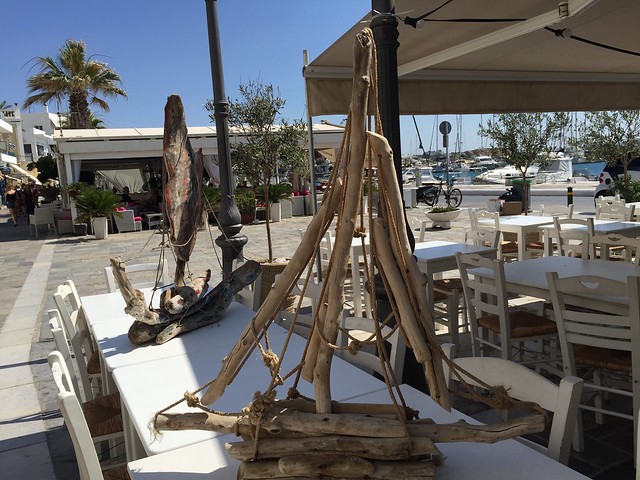
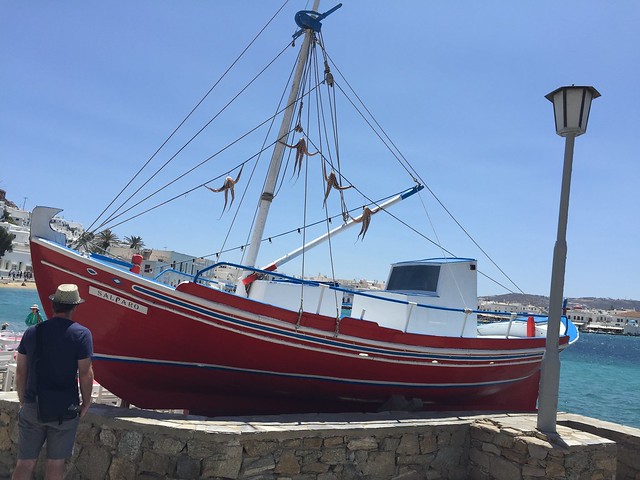
Photographic Records of Crete, Naxos, Delos and Mykonos

Now that I’ve had some time (three days) back at home before we leave again for another (more mundane) trip, I’m posting pics from Greece.  Enjoy!

Crete

Crete

Naxos

Naxos

Delos

Delos

Mykonos

Mykonos

Crete: Even Ancient History has an Ancient History

First photograph is of the town of Chora, Naxos seen through the ruins of the Apollo temple.

Today we leave Crete, traveling on to the second half of our journey — studying Derrida in Italy.  What has been most impressed upon me during our time in Crete is how much human history precedes what I think of as the beginnings of history.  As someone who teaches and writes about ancient Greek philosophy, I’m often trying to get students to think about how Greek thinkers are in conversation with their context and how we remain in conversation with the Greeks as part of our context.  It’s not just that students don’t understand the thinking of the Greeks without understanding their context, it’s that they don’t think that the Greeks have a rich context.  If we just think the Athenians consider themselves to have sprung out of the ground–to be autochthonous, to come from where they are–and we know of nothing that precedes them, this might seem like a reasonable claim, one we have no cause to be suspicious of, just like Americans assuming that we have more claim to be here, we have who have been here for ten generations, than those who are just arriving if we know nothing of the history of what preceded our ancestors ten to fifteen generations ago. Read more