Skip to content

Obama’s Farewell Address: Form a More Perfect Union

Every time Obama gives these appeals to “the better angels of our nature,” I’m right there back with him.  My fellow Americans, he kept saying last night in his farewell address from Chicago.  Someone recently pointed out that the incoming president seems to only tweet to his supporters, while Obama again and again addresses the whole country.  I felt like he was keeping us honest, inspired and going when he said, “These conversations have kept me honest, they kept me inspired and they kept me going.”

The circumstances of Obama’s exit from office make him seem particularly concerned with encouraging the country not to give up hope.  I don’t recall hearing any previous president who was handing over power to the opposing party speak with this kind of charge to the country with the praise for “The quiet dignity of working people in the face of struggle.”  I tend not to think that electoral politics is or should be the site of our political focus, but I’m concerned that this critique of electoral politics sometimes amounts to general withdrawal from the halls of power.  I don’t think that nothing can be done to put pressure on elected officials.  The Tea Party and #BlackLivesMatter are evidence to the contrary.  And it seemed like the Obama who showed up for the Farewell Address was the community organizer Obama who was making this case to the American people.

Change only happens when ordinary people get involved, get engaged, and come together to demand it.

These rights, while self-evident, have never been self-executing; that We, the People, through the instrument of our democracy, can form a more perfect union.

All of this depends on our participation, on each of us accepting the responsibility of citizenship, regardless of which way the pendulum of power swings.

Our Constitution is a remarkable, beautiful gift.  But it’s really just a piece of parchment.  It has no power on its own.  We, the people, give it power–with our participation and with the choices we make and the alliances that we forge.

It falls to each of us to be those anxious jealous guardians of our democracy.

Look, there’s a lot that we could take issue with, like how Obama’s own policies contributed to some of the problems he called for vigilance against, like that “Stark inequality” that “is corrosive to democracy.”  Or the various prosecutions like of Edward Snowden and Chelsea Manning that did not appear to “Guard against a weakening of the values that make us who we are.”  Some might actually guffaw at Obama’s statement that we “reformed our laws to protect privacy and civil liberties.”  Or at the way that the United States demands “respect for freedom and the rule of law” for the sake of global tranquility while enforcing its will through military might and allowing police officers to kill citizens with impunity.

We could also take issue with the obstacles to ordinary people having an effect on the government that are part of our system–from money in elections to the electoral college.  Or with how the constitution and democracy might not feel to all parts of the community as things worth preserving.  And yet still, Obama’s call makes me want to organize.  I’m particularly struck by how he calls us to get together with other people.

I recently heard Jodi Dean on “This is Hell!” talking about how damaging the concept of individualism can be.  One way I think it can be damaging is that it makes us feel overwhelmed by individual responsibility, and it makes it difficult for us to be creative about being a collective.  Dean pointed how even Occupy Wall Street fostered an individual sense of choice where collective action depended on the individual assent for the sake of consensus of the whole gathered assembly.  Dean encourages a way of thinking about collectives that doesn’t focus on individual assent and choice, but on actions that serve the collective that then present people with the opportunity to do something.  I realize that this risks getting into a Lenin vs. Trotsky debate or something, which isn’t really my point.  My point is that I want to be with Obama against cynicism.  I do not want cynicism to produce inaction.  I think it might because it operates on individuals, who feel helpless.  But groups are not helpless and without effect. Even small and persistent groups can give the constitution meaning.

The best line in the address to my mind was about how rights that are self-evident are not self-executed.  I’m wary of rights talk grounding political life, and I’m not sure that these rights are self-evident, but I appreciate Obama’s charge that they are not self-executed.  Not self-executed I’m not sure really want it means to consider these rights individual rights, but civil rights in the sense of needing a community to get off the ground.  We’ve long been considering the argument that rights have no force on their own without a power to give them force.  Hannah Arendt suggests in The Origins of Totalitarianism that these kinds of rights, the ones we might call human rights, are without force unless there is a government who can recognize them.  Jacques Rancière responds that these rights can be made evident by a certain activity that manifests the way they are being ignored or the injustice of their not being extended to those to whom they ought to extend.  What might it mean for us to recognize that these rights are not self-executed, “but we the people through the instrument of our democracy can form a more perfect union”?  I don’t think Obama meant through elections.  We could form a more perfect union by forging alliances [this phrase was not in the distributed speech but added by Obama in the moment] wherein we treating as having rights those for whom these rights are not self-evident to others.  This work is going to be the work of (at least) the next four years.

“Be vigilant but not afraid.”


On Ending Whiteness

In Ta-Nehisi Coates’ Between the World and Me (see these collected reviews), Coates refers to “people who believe they are white.”  In his 2004 book, The Abolition of White Democracy, Joel Olson says he will capitalize Black when referring to people of African descent in the book because Black refers to a culture, but white does not (xviii-xix).   Read more

Advice for Scholarly Writing From My Experience Refereeing for Journals

Having had some publishing success in my career, I’ve been rewarded with tons of requests to review article manuscripts in the last couple years.  I am still not jaded enough to dislike being called on or not to need the recognition as an expert by editors such requests indicate.  I appreciate having some influence on the field that this work affords.  It also affords me the awareness of some common pitfalls.  To avoid them, I offer this advice. Read more

On Experts and Political Expertise, Again

This cartoon was circulated on social media last week by people concerned that the knowledge of experts is no longer respected in political matters.  Last week I blogged about the hatred of democracy that I think underlies this sentiment.  In November, I blogged about the “best and the brightest” political experts who were supposed to lead us into the path of peace and prosperity but instead enmired us in an unwinnable war.  I’m on an expert on some things.  I think that expertise should be recognized and I bristle when it is not, so I appreciate the concern that experts aren’t taken seriously. Read more

The OA (SPOILERS)

When I was in high school I read John Irving’s novel, A Prayer for Owen Meany.  The OA has the same structure of a story as that novel.  The structure of the story is the spoiler of the whole thing so really if you don’t want to be spoiled on the novel or The OA, do not read any further.   Read more

Podcast Recommendations

I like to listen to podcasts as I work and as I run.  But finding good podcasts that are worth my time is no easy task.  Even when I find recommendations, I never know where to start.  Here is a list of podcasts I listen to, why I like them and why I hate-listen to others.  I’ve included the particular episodes that I thought were standouts and that I come back to regularly or even assign in classes.  They are in no particular order. Read more

Christianity Without Metaphysics

There’s a debate swirling in the PCA circles I grew up in about how one should respond to doubt in Christianity.  It started with Nicholas Kristof’s interview with Tim Keller in the New York Times that led to this response from Pete Enns, a dispute that was written up here.  Enns is concerned that Keller does not take seriously the questions sympathetic sorts have for Christianity about things like the virgin birth and the resurrection.  As Enns argues, these aren’t just questions about the compatibility of such claims with science but more the inconsistency of the Biblical texts themselves on these points.  The problem for me was never these particular points but with the account of the specific workings of a substitutional atonement understanding of Christianity.  Why was God restrained by a formula that demanded the death of God in order for things to be right with human beings?  How could a cosmic formula or justice or call it what you will constrain an all-powerful God?   How did believing or failing to believe certain things about what happened two thousand years ago have a metaphysical effect on the destiny of my soul? Read more

False Equivalencies and Liberalism

There was a lot of talk during the general election cycle about false equivalencies in the coverage of the two major party candidates.  The concern was that vastly different actions were treated as similar under the guise of journalistic balance or objectivity: Clinton’s emails treated with the same degree of coverage as Trump’s recorded statement about how he grabs women.  But these false equivalencies have moved beyond election coverage.  Identity politics, a term that refers to political efforts by groups who are marginalized on the basis of some aspect of their identity, has been taken up by those who occupy the position of the norm–Christians, white people, men–and made equivalent to the political efforts of those whose identities make them the systemic targets of injustice.  An opinion piece in The Washington Post argued that Democrats lost this election because of SCOTUS decisions against Christians’ rights to refuse to bake cakes for gay weddings.  Jeremy Carl argued last August for the legitimacy of white interests in National Review.  New York Magazine reports on the revitalization and politicization of the men’s rights movement in the era of Trump.  The idea in each of these cases is that the identities of those who because of their identity are structurally situated as having power occupies an equivalent political position to those who because of their identity are structurally situated as lacking power.

There has been a lot of wringing of hands over the move toward false equivalencies of this kind.  I submit that this situation in which every identity is treated as equal to every other one is what is on offer from liberalism, and here I mean liberalism in the sense of the political theory that both parties in the United States affirm.   Read more

The Hatred of Democracy

The last weekend in October of last year, I was at the former Labyrinth Bookstore in New York City where I picked up Jacques Rancière’s The Hatred of Democracy.  Ten days later, the country would elect Donald Trump to the presidency.  Since then (and well before), the cries against democracy have come in from many corners.  Jason Brennan, philosopher at Georgetown, wrote a book Against Democracy in which he calls for an epistocracy.  Andrew Sullivan argues that democracies end when they are too democratic in New York Magazine.  Caleb Crain discusses the case against it in The New Yorker in the issue published the week before the election.  Crain quotes the famous Winston Churchill line, democracy is the worst form of government except for all the others that have been tried from time to time.  That line put me in mind of what Chesterton said about Christianity, that it hasn’t been tried and found wanting, it has been found difficult and not tried.  Or perhaps not difficult, but scandalous.  This I believe is what Rancière is arguing about democracy.

Rancière makes three relevant points. First, the people are dismissed as problematic because of a process that divides democratic politics from democratic society and then denigrates all that is associated with democratic society.  Second, democracy is a rule without measure, without legitimacy (which is why lottery is the most, perhaps the only true, democratic form of choosing leaders). All efforts to establish legitimacy set up a rationale for rule that make that measure and not the people as such, the source of legitimacy.  Third, voting in representative governments is a ruse that gives cover to oligarchic regimes.  I argue on the basis of this analysis that blaming democracy or the people in a situation that is not democratic legitimates anti-democratic policies and processes in a system that already was anti-democratic. Read more

Day 2: The Best of the Worst of Years

People seem generally agreed that 2016 was a crap year.  The best people died and the worst people won.  In the face of this crappiness, I sat down to think about the happy things of this past year. I made this list before Carrie Fisher and Debbie Reynolds died and before a colleague was harassed by white supremacists for mocking their racist concepts and now I don’t have much enthusiasm for sharing it. I’m concerned about focusing on my individual successes in the face of collective adversity. I know that the political losses of this year and the emboldening of the agents of injustice will require vigilance and thoughtfulness for the sake of creating a new and better world. I recall the good things of the year then in the spirit of possibility for doing that work. 

  • It was my first year as a tenured professor.
  • I’m on my first sabbatical.
  • We bought a house!  img_0950
  • We moved to a big(gish) city.
  • I turned 40.
  • Some really great people came to visit.
    img_0968

    Leigh Johnson made her way to Indianapolis for a weekend-long jam session.

    img_1086

    Villanova in Indiana

    img_0961

    Jay Blossom sighting

    img_0948

    The Johnsons stopped in all the way from Sharyland, TX.

    img_0683

    Happy birthday to me with nieces and nephew who visited us in Indiana for my birthday.

  • I had a gloriously sunny Cape May vacation with the nieces and nephews and sisters.
    img_1152

    The Nabors kids in Cape May.

  • I gave some good talks and got some good feedback on the book project I’m working on.
  • I went to the Eastern APA, philoSophia, Ancient Philosophy Society, Wonder and the Natural World, Feminist Ethics, Methodologies, Metaphysics and Science Studies, SPEP, Society for Ancient Greek Philosophy, IPA conferences this year. 
  • I reconnected with old friends in Philadelphia and New York City.
  • I attended a dear friend’s wedding.
  • I found a running group in Indianapolis.
  • I’ve been doing a reading group on some stuff I’ve been thinking about in the background for awhile and am glad to get into deeper.
  • I made some new friends in Indianapolis.

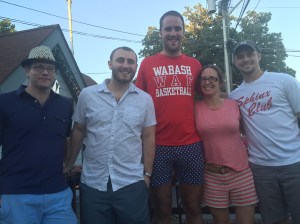
I’ve been in close contact with alum from the last three institutions I’ve taught at (Wabash, UTPA, and Bryn Mawr).

img_0991

Wabash in Broad Ripple

Lunch with Wes Chamblee in South Bend

Lunch with Wes Chamblee in South Bend

The celebrity deaths, the lack of indictments for police shootings of Black people, emboldened racism, anti-Semitism and misogyny, Brexit, the political situation in Turkey, the surprising election all made it a year of possibilities foreclosed.  At the same time, it was for me a year that established new possibilities- a new house, a new city, the tenured life, sabbatical. I’m not entirely sure how to hold these things together. I’m working to make my own new possibilities a place from which to address and resist the foreclosed ones. 

The featured image is of the lighthouse at Cape May, NJ, lit by the sun.  I leave it here as a metaphorical demand for lighthouses.