Skip to content

Advice for Scholarly Writing From My Experience Refereeing for Journals

Having had some publishing success in my career, I’ve been rewarded with tons of requests to review article manuscripts in the last couple years.  I am still not jaded enough to dislike being called on or not to need the recognition as an expert by editors such requests indicate.  I appreciate having some influence on the field that this work affords.  It also affords me the awareness of some common pitfalls.  To avoid them, I offer this advice. Read more

On Experts and Political Expertise, Again

This cartoon was circulated on social media last week by people concerned that the knowledge of experts is no longer respected in political matters.  Last week I blogged about the hatred of democracy that I think underlies this sentiment.  In November, I blogged about the “best and the brightest” political experts who were supposed to lead us into the path of peace and prosperity but instead enmired us in an unwinnable war.  I’m on an expert on some things.  I think that expertise should be recognized and I bristle when it is not, so I appreciate the concern that experts aren’t taken seriously. Read more

The OA (SPOILERS)

When I was in high school I read John Irving’s novel, A Prayer for Owen Meany.  The OA has the same structure of a story as that novel.  The structure of the story is the spoiler of the whole thing so really if you don’t want to be spoiled on the novel or The OA, do not read any further.   Read more

Podcast Recommendations

I like to listen to podcasts as I work and as I run.  But finding good podcasts that are worth my time is no easy task.  Even when I find recommendations, I never know where to start.  Here is a list of podcasts I listen to, why I like them and why I hate-listen to others.  I’ve included the particular episodes that I thought were standouts and that I come back to regularly or even assign in classes.  They are in no particular order. Read more

Christianity Without Metaphysics

There’s a debate swirling in the PCA circles I grew up in about how one should respond to doubt in Christianity.  It started with Nicholas Kristof’s interview with Tim Keller in the New York Times that led to this response from Pete Enns, a dispute that was written up here.  Enns is concerned that Keller does not take seriously the questions sympathetic sorts have for Christianity about things like the virgin birth and the resurrection.  As Enns argues, these aren’t just questions about the compatibility of such claims with science but more the inconsistency of the Biblical texts themselves on these points.  The problem for me was never these particular points but with the account of the specific workings of a substitutional atonement understanding of Christianity.  Why was God restrained by a formula that demanded the death of God in order for things to be right with human beings?  How could a cosmic formula or justice or call it what you will constrain an all-powerful God?   How did believing or failing to believe certain things about what happened two thousand years ago have a metaphysical effect on the destiny of my soul? Read more

False Equivalencies and Liberalism

There was a lot of talk during the general election cycle about false equivalencies in the coverage of the two major party candidates.  The concern was that vastly different actions were treated as similar under the guise of journalistic balance or objectivity: Clinton’s emails treated with the same degree of coverage as Trump’s recorded statement about how he grabs women.  But these false equivalencies have moved beyond election coverage.  Identity politics, a term that refers to political efforts by groups who are marginalized on the basis of some aspect of their identity, has been taken up by those who occupy the position of the norm–Christians, white people, men–and made equivalent to the political efforts of those whose identities make them the systemic targets of injustice.  An opinion piece in The Washington Post argued that Democrats lost this election because of SCOTUS decisions against Christians’ rights to refuse to bake cakes for gay weddings.  Jeremy Carl argued last August for the legitimacy of white interests in National Review.  New York Magazine reports on the revitalization and politicization of the men’s rights movement in the era of Trump.  The idea in each of these cases is that the identities of those who because of their identity are structurally situated as having power occupies an equivalent political position to those who because of their identity are structurally situated as lacking power.

There has been a lot of wringing of hands over the move toward false equivalencies of this kind.  I submit that this situation in which every identity is treated as equal to every other one is what is on offer from liberalism, and here I mean liberalism in the sense of the political theory that both parties in the United States affirm.   Read more

The Hatred of Democracy

The last weekend in October of last year, I was at the former Labyrinth Bookstore in New York City where I picked up Jacques Rancière’s The Hatred of Democracy.  Ten days later, the country would elect Donald Trump to the presidency.  Since then (and well before), the cries against democracy have come in from many corners.  Jason Brennan, philosopher at Georgetown, wrote a book Against Democracy in which he calls for an epistocracy.  Andrew Sullivan argues that democracies end when they are too democratic in New York Magazine.  Caleb Crain discusses the case against it in The New Yorker in the issue published the week before the election.  Crain quotes the famous Winston Churchill line, democracy is the worst form of government except for all the others that have been tried from time to time.  That line put me in mind of what Chesterton said about Christianity, that it hasn’t been tried and found wanting, it has been found difficult and not tried.  Or perhaps not difficult, but scandalous.  This I believe is what Rancière is arguing about democracy.

Rancière makes three relevant points. First, the people are dismissed as problematic because of a process that divides democratic politics from democratic society and then denigrates all that is associated with democratic society.  Second, democracy is a rule without measure, without legitimacy (which is why lottery is the most, perhaps the only true, democratic form of choosing leaders). All efforts to establish legitimacy set up a rationale for rule that make that measure and not the people as such, the source of legitimacy.  Third, voting in representative governments is a ruse that gives cover to oligarchic regimes.  I argue on the basis of this analysis that blaming democracy or the people in a situation that is not democratic legitimates anti-democratic policies and processes in a system that already was anti-democratic. Read more

Day 2: The Best of the Worst of Years

People seem generally agreed that 2016 was a crap year.  The best people died and the worst people won.  In the face of this crappiness, I sat down to think about the happy things of this past year. I made this list before Carrie Fisher and Debbie Reynolds died and before a colleague was harassed by white supremacists for mocking their racist concepts and now I don’t have much enthusiasm for sharing it. I’m concerned about focusing on my individual successes in the face of collective adversity. I know that the political losses of this year and the emboldening of the agents of injustice will require vigilance and thoughtfulness for the sake of creating a new and better world. I recall the good things of the year then in the spirit of possibility for doing that work. 

  • It was my first year as a tenured professor.
  • I’m on my first sabbatical.
  • We bought a house!  img_0950
  • We moved to a big(gish) city.
  • I turned 40.
  • Some really great people came to visit.
    img_0968

    Leigh Johnson made her way to Indianapolis for a weekend-long jam session.

    img_1086

    Villanova in Indiana

    img_0961

    Jay Blossom sighting

    img_0948

    The Johnsons stopped in all the way from Sharyland, TX.

    img_0683

    Happy birthday to me with nieces and nephew who visited us in Indiana for my birthday.

  • I had a gloriously sunny Cape May vacation with the nieces and nephews and sisters.
    img_1152

    The Nabors kids in Cape May.

  • I gave some good talks and got some good feedback on the book project I’m working on.
  • I went to the Eastern APA, philoSophia, Ancient Philosophy Society, Wonder and the Natural World, Feminist Ethics, Methodologies, Metaphysics and Science Studies, SPEP, Society for Ancient Greek Philosophy, IPA conferences this year. 
  • I reconnected with old friends in Philadelphia and New York City.
  • I attended a dear friend’s wedding.
  • I found a running group in Indianapolis.
  • I’ve been doing a reading group on some stuff I’ve been thinking about in the background for awhile and am glad to get into deeper.
  • I made some new friends in Indianapolis.

I’ve been in close contact with alum from the last three institutions I’ve taught at (Wabash, UTPA, and Bryn Mawr).
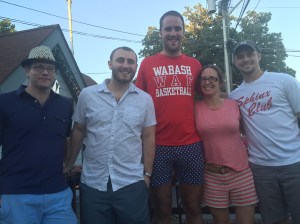
img_0991

Wabash in Broad Ripple

Lunch with Wes Chamblee in South Bend

Lunch with Wes Chamblee in South Bend

The celebrity deaths, the lack of indictments for police shootings of Black people, emboldened racism, anti-Semitism and misogyny, Brexit, the political situation in Turkey, the surprising election all made it a year of possibilities foreclosed.  At the same time, it was for me a year that established new possibilities- a new house, a new city, the tenured life, sabbatical. I’m not entirely sure how to hold these things together. I’m working to make my own new possibilities a place from which to address and resist the foreclosed ones. 

The featured image is of the lighthouse at Cape May, NJ, lit by the sun.  I leave it here as a metaphorical demand for lighthouses.


    Day 1: 31 Days of Blogging

    Last January, inspired by Jill Stauffer and looking to blog more regularly, I decided to blog every day of January. It was hard, but it was good for me. It was an opportunity to think through some things that had been rattling around in my head, to write up some reviews of books, and to better articulate my thoughts on what was happening in the world. No doubt there were days that were hard, but it broke through some of my blogging anxieties making it easier for me to drop a post without too much concern over whether my contribution really was a contribution.

    Now a year later, those anxieties have not remained at bay. This is partly due to my efforts to address multiple audiences at once and partly due to my conflicted feelings about the philosophy blogosphere. Instead of getting into that here, I am going to start with my positive account of how I would like to think about blogging, my community of bloggers and my audience.

    1. I would like to be writing for a community of philosophers and non philosophers alike. This means a whole bunch of things that I think should lower the stakes of regular blogging. For one, it means writing plainly without trying to prove philosophy credentials. That means writing from a place of my expertise, but without the formal structures that demand that expertise be proven at every turn.
    2. For another, it means writing things because I think about them and am interested in sharing them.  I know some things, I know the world in which these things are discussed. I have specific investments and concerns about how we think about political life, about nature, about gender, about reading certain texts that I am interested in writing about. I’m going to actively strive to overcome my resistance to posting when I am unsure whether what I write has been said before. A, I don’t think it has and B, this is not a formal academic project that depends on the principles of academic research. Unfortunately, this sense that it is is often enforced on women bloggers while many allowances are made for men bloggers.
    3. I would like to have a community around blogging that responds graciously and thoughtfully, reading with a hermeneutics of sympathy, giving the author the benefit of the doubt, respecting her authority on those things in which she is an authority. This is a principle that often leads to false equivalences, something I hope to write about in the days to come.  I’ll just say that recognizing social and disciplinary positioning and responding thoughtfully in light of those positions would make this a better blog world.

    One reason I have an uneasy relationship to blogging is that I want to treat it as a kind of public note-taking of my thinking about the world, much as Chris Long writes about using Twitter. By being public I am compelled to work things out that might otherwise be left inchoate. But also by being public I find myself internalizing possible criticisms and concerns from comers on all sides. This Big O Other, law of the father, this gaze, whatever you want to call it is a view I’d like to better ignore. So this month I’d like to blog more consciously for myself. If that’s something you’re interested in following, I hope you do.  I’ll let you know at month’s end how we fare.

    The Best and the Brightest and Accidental History

    This week we learned that the Trump team didn’t realize they had to replace all the staff in the White House, that the Trump transition team has been re-organized several times, perhaps in part because his son-in-law, Jared Kushner wants to settle a personal score against Chris Christie, and that Ivanka Trump is using her dad’s election to hawk some bracelets in her line.  If you’re like me, you are little freaked out not only by the political commitments of this coming Administration, but how ill-prepared they seem.  I want to assure you–being well prepared might not be much better.

    This week, as I’ve been hearing these things, I’ve been reading David Halberstam’s ironically titled historical account of the minds that together brought us the policies of the Cold War, and thus the Vietnam War and its failures–The Best and the Brightest.  What is clear in this book is that failures of personality, of individual insecurity, of a country wanting to prove itself led to decisions that were later defended as inevitable and necessary. Read more