Metablogging: Blogging about Academic Blogging
Why I started blogging and how its been more of a benefit that I expected.
Aug 22

Why I started blogging and how its been more of a benefit that I expected.
Since I last posted on the question of whether what we think makes us good or bad people, my thoughts keep returning to how difficult this question is. To reiterate, when I say, what we think might make us good or bad people, I don’t mean whether we think about doing what we might generally acknowledge to be bad things — that you think about how to hurt someone might set you on the path to being a bad person, or that you think hateful thoughts toward someone is likely to make you hurt them, or you think it is good to get ahead by taking advantage of other people. I think the value of those kinds of thoughts is less controversial. What I am considering is whether the ways you think about what is–what we call ontological claims–makes you a good or bad person. Read more
Jul 22
Last week, I finally sat down with some friends and watched the 2012 film, “Hannah Arendt,” by Margarethe von Trotta. The film focuses on Arendt’s trip to Israel to watch the Eichmann trial and the writing of her article for The New Yorker on the trial, Eichmann in Jerusalem. With nice timing, The New Yorker is making its archives including this article available for a limited time on its website so check it out here. Arendt argues in that essay that what was most appalling about the trial and about Eichmann and most frightening for a political environment tending more and more to totalitarianism was that Eichmann did not claim to think. Read more
I wrote most of this post in Nafplio, living close to nature. The photograph is of the abandoned robin’s nest found in our hanging ivy planter.
There’s been a resurgence of conversation in philosophy about the role of the nonhuman in recent years. I’ll be honest, I haven’t given it that much thought. But I came to this ah-hah moment the other day in conversation with my lovely husband about sacrifice as the production of the distinction between gods and beasts and the subsequent production of the space in between: the site of the mortal. How sacrifice does that is complicated (see Vernant, Girard, Burkart and Agamben), but the implication of this account is that the line between the beast and the human (and the god) needs to be produced. Read more
I spent the last two days attending the Faculty Workshop on Democracy and Civic Engagement at Wabash that was organized and facilitated mostly by members of the Rhetoric Department at Wabash. It’s been glorious to slow down and take some time to think about the teaching we spend so much time doing, so I’m feeling rejuvenated and enthusiastic about planning for civic engagement components in the classroom. One issue that kept recurring for me was the tension between, or at least, the question of whether there is a tension between, thinking and acting. Plato and Aristotle both distinguish between actions you do for themselves and actions you do for some end outside of themselves, and they argue that actions that you do for themselves are better than actions you do for some product or goal beyond the action. I found myself concerned that measuring the success of a course in terms of some action that might come of it beyond the thinking that takes place within it privileges action and makes thinking instrumental to action. This dispute reaches back to the ancients. In Politics VII.3, Aristotle remarks that some people think that politics is a better life than philosophy because they think that politics is action but philosophy is not. Aristotle accepts the view that a life of action is better than a life of inaction, but he rejects the idea that philosophy is not action in itself. Read more


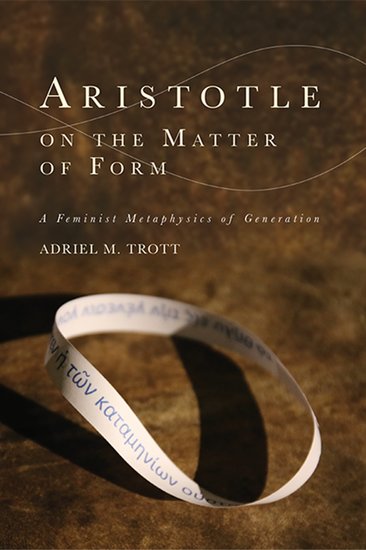
I'm Chair and Associate Professor of Philosophy at Wabash College in Crawfordsville, Indiana. I work on ancient Greek--mainly Plato and Aristotle--and contemporary European philosophy inflected by social and political concerns. I'm particularly interested in the concept of nature and how historically nature, understood in relation to its apparent opposite of reason, nature, and artifice, has led to conceptions of community that require a founding exclusion. My first book argues that Aristotle's Politicsdraws on a conception of nature that is not opposed to these things and thus not exclusive. My second book considers Aristotle's conception of nature in his account of generation to show the ways that form and matter seem interdependent in the model of a Möbius strip.
I am serious about running. I care about justice, feminism, opposing racism and resisting neoliberalism. I think Socrates was on to something when he suggested thinking was a practice of living. I teach students to think--and to live. I delight in the pleasures of doing the difficult thing.