Today was the first day of the Ancient Philosophy Society in Portland, Maine, hosted by Jill Gordon at Colby College. A new day has dawned for the APS when so much discussion of gender in ancient philosophy and explicitly of feminist approaches to ancient philosophy is given center stage. I was planning on posting a blog on the conference as a whole, but today’s program was so rich, and so focused on gender, that it deserves a post of its own. Read more
In January, I was blogging regularly about what is required to motivate change, a move from inaction to action, from one view to another, from not caring to caring. I pointed out then that just telling someone their position is contradictory rarely moves them to change their position.
Today, I heard yet another podcast (see this one too) discuss Samantha Bee’s new show, Full Frontal with Samantha Bee. On this podcast, Stephen Metcalf of Slate says:
I may have reached my limit for “let them eat satire.” The debasement of as culture, especially political culture, as raw material for the late night shows, and this is the kind of comedy placebo that I swallow on a nightly basis to wake up as a functionally sane human being. I’ve kind of reached the end of it in a weird way, I’ve kind of, I want, I want rage and political action. I don’t want to laugh, however on point the satire is.
I was listening to the DoubleX podcast this morning because I promised awhile ago to blog my reflections on it more often. They were talking about the “tampon tax” and how there’s a new “period feminism” about owning your period, and wow, isn’t it weird how menstruation seems to somehow capture men’s fears about women? I was annoyed. And I realized, I was annoyed for the same reasons from the last time I blogged about this podcast–they aren’t experts on a subject that does in fact have experts. There are people (like my new fave, Helen King) who work in gender theory who talk about how menstruation going back to the ancient Greeks captures something of the male anxiety about women’s reproductive capacities and death–you know, the whole shedding of blood bit.
I haven’t been blogging much this month because I haven’t felt like I was an expert on the various issues and ideas that I’ve considered in the last month or so (though, I gotta tell you, once I thought about how I really should blog, all of a sudden, I could think of four different posts I had to write, so I think thinking-towards-the-blog is itself productive of thinking). The political moment we live in seems to be one of a general disparagement of those who claim to be experts, and mocking the experts is something of an American pastime (consider the glee directed at Nate Silver’s fails). I might be chagrined that Trump has benefited from the decline of respect for expert knowledge, but I share this skepticism of the rising class of technocrats. When economists say we are the experts, we can fix the economy, and only we can figure it out because it is so complicated, I start to worry. Whenever anyone says, this is just a matter of the right knowledge, and the one with the right knowledge, that is the person who gets to rule, their claim is more of a political one than an epistemological one. Read more
On March 12, 2016 at the University of Colorado, Denver, at the meeting of PhiloSophia: Society for Continental Feminism, I will be speaking on an Author Meets Critics panel discussing Robin James’ recent book. Below are my comments.
I like this book. I like how Robin James says important things to a popular audience from a background in academic philosophy that remains unbeholden to that world. I like her independent voice. I like how, in Resilience & Melancholy: Pop Music, Feminism, Neoliberalism, James exemplifies what philosophizing out of a singular moment and specific site looks like. Her moment is neoliberalism and her site is pop music. James uses music as more than an example; in her hands, music is a place for developing a conceptual apparatus for neoliberalism. In music, we hear how the demand to turn damage into something productive works to make oppressed persons assimilate into the neoliberal apparatus.
James references a whole slew of sources that signal the breadth of her influences in this project–from Adorno and Marcuse to Deleuze and Guattari, queer theorists Jack Halberstam and José Estabon Muñoz, New Media Studies theorist Steven Shaviro, political theorists like Jodi Dean, Lester Spence and Mark Neocleous, as well as cultural studies scholars like Zandria Robinson. Beyond those we recognize as theorists, James draws insight out of the work of pop musicians Lady Gaga and Beyoncé, Atari Teenage Riot and Rihanna. With this book, James expands the sphere of those figures worth putting to work in philosophy, just as her working out of music multiplies the sites in which thinking occurs outside of the center of well-respected philosophical discourse.
In this comment I move back to those well-respected in philosophical discourse, somewhat abashedly and certainly not because I think James’ argument needs to be put in conversation with those folks in order to gain legitimacy. By no means. James’ work addresses a strain in political philosophy that shows her to be calling into question, even turning on its head, the structural framework within which we have thought about how to expand the sphere of the political to include those at the margins. It’s fitting that this structure is turned on its head through voices unheard in philosophy. Read more
I’ve had Jason Stanley’s book How Propaganda Works (Princeton 2015) sitting on my desk for a couple months and finally, this week, I read through most of it. I think it’s an important book for a number of reasons, particularly because I think it addresses and attempts to remedy some of the issues and concerns about how analytic philosophers do political philosophy that have kept many continental philosophers from thinking that this work was worth engaging. But it’s also interesting to me because I’ve been blogging a bit about the difficulties of changing people’s minds, a difficulty that I think Plato addresses in his dialogues.
In the Introduction, “The Problem of Propaganda,” Stanley maintains that (1) Plato is seeking to describe the ideal polity, which is an aristocracy of philosophers, (2) Plato is a fierce critic of democracy, and (3) Plato is concerned with how political systems will work in light of “actual social and psychological facts about humans” (9). I want to suggest in what follows that while in the course of the dialogue Socrates says things that seem to lead to 1 and 2, it is not clear that either Socrates or Plato is propagating those views. (I agree with (3) and I’ll discuss that in the next post.) I maintain that Plato writes a dialogue full of unsupported and problematic claims that lead to a certain account of what political life would be like on the basis of those unsupported and problematic claims in order to prompt considered thinking in Socrates’ interlocutors and in Plato’s readers. I believe that Plato thinks this willingness to challenge our most settled beliefs is central to avoiding the pitfalls of democracy which arise in the first book of his Republic – I think the efforts Plato depicts of Socrates to prompt thinking in reflection in political life in a number of different contexts is further evidence for this view. Read more
In the first book of Plato’s Republic, Plato has Socrates turn to the medical art in order to argue that justice like other technai, or knowledges that serve some practical purpose, benefit those they serve rather than those who have the knowledge. Socrates is responding to Thrasymachus who thinks justice is a purely conventional effort to use one’s power to serve themselves. Socrates, as is his wont in Platonic dialogues, introduces the question of knowledge–how can we serve ourselves if we do not know what would serve us well? Having Thrasymachus agree that we expect the ruled to obey, and that if they were to obey when the ruler was wrong about what serves him well, Socrates also gets Thrasymachus to agree that this view would have justice be both serving the rulers’ end and not. Thrasymachus explains himself by saying the ruler is only the ruler when the ruler is right about what his advantage is. Read more
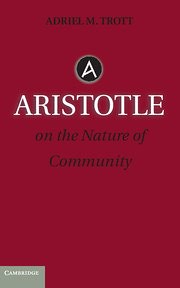
In my book on Aristotle’s Politics, I argue that Aristotle’s definition of the human being as political on the basis of having logos, by which we organize pleasures and pains and determine what is beneficial and harmful, good and bad, just and unjust, functions to show that anyone making a claim to belong exemplifies their having of logos and thus belongs. Interestingly, I think this view might actually lead to showing, contra Aristotle’s argument that logos distinguishes humans from animals, that animals too might make claims and thus belong. I take Bruno Latour’s work on the politics of nature to show as much.
I’m currently working on a project on Aristotle’s biology, which has led me into some background research on ancient Greek medicine that has further complicated the question of how and whether we can use logos and phônê to distinguish humans from animals. Read more
This month I have found myself thinking about the ways that concepts from commercial life have come to pervade our thinking about ethical and political life to our detriment. Debt economics was one way. Efficiency is another.
In Republic II, Plato has Socrates justify having each person in the city do one task with recourse to efficiency. What would be more efficient? Accepting this point and the notion that each person has a nature suited to only one particular task leads to the city where each person is assigned a place. Multiple machinations and myths are required to keep things in that order. I believe that Plato is showcasing to us a political order based on a series of assumptions that he does not defend in order to challenge those assumptions. One of those assumptions is that efficiency is good for human beings. Read more
On New Year’s Eve, I went to the Field Museum in Chicago to see its special exhibit on the Greeks. The Museum has collected 500 artifacts from Greek museums, which cover 3500 years of history, beginning with the Minoans on Crete and other Cycladic islands. I had seen many of these pieces in their home museum, which admittedly, is already pulled from the original context, but seemed at least to beckon to the sense of the place from which they were found. Seeing them all pulled together robbed them of their aura (in the Benjaminian sense), it seemed to me. I’m glad they could pull it together for people to see, but I just want to put the plug in for going and visiting places and the museums in those places.
Aristotle scholars spend a lot of time arguing over whether and in what way a life of action, what is called a ‘practical life’ (from the Greek praxis), which includes a life focused on ethical and political concerns, can possibly achieve happiness, or whether only contemplation — the theoretical life of the philosopher or thinker or scientist — can achieve complete happiness for human beings. Commenters suppose from several chapters in Nicomachean Ethics X.7 that the case is obviously on the side of contemplation. Then they fight over how to limit that claim or re-interpret it.
But today, I’ve been prepping those passages to teach and I just don’t think they add up to the obviously strong argument for contemplation against deliberation that pretty much everyone who reads Aristotle seems to think they do. One argument in particular — that it’s what the gods do — seems just not the case. What the heck then is Aristotle doing? Here’s what Aristotle writes:
But that complete happiness is a certain contemplative activity would appear also from this: we have supposed that the gods especially are blessed and happy–but what sort of actions ought we to assign to them? Just acts? Or will they appear laughable as they make contracts, return deposits, and do anything else of that sort? But what about courageous acts? Do the gods endure frightening things and run risks, because doing so is noble? Or liberal acts? But to whom will they give? And it is strange if they too will have legal currency or something of that sort. And what would their moderate acts be? Or is the praise, “they do not have base desires,” a crude one? All that pertains to actions would appear, to those who go through it, petty and unworthy of gods. (1178b8-17, Bartlett and Collins translation)
Puh-lease, Aristotle. It seems just as likely from all this that the gods don’t do any of these things because the gods don’t really live virtuous lives. Do the gods do just acts? No, Zeus steals women and cheats on Hera on the regular. The whole of Hesiod’s Theogony seems to be about the frightening risk-taking acts of gods. But no, not because it’s noble. They want power, or they’re just bored. Liberal acts? Well, basically, that seems to be all of Homer and most of Hesiod where Zeus gives things to gods, and that part where Zeus and Prometheus divide stuff up and give it out. “And what would be their moderate acts?” Got me there, Aristotle: we don’t know, because no god has yet to be moderate. Read more
I'm Chair and Associate Professor of Philosophy at Wabash College in Crawfordsville, Indiana. I work on ancient Greek--mainly Plato and Aristotle--and contemporary European philosophy inflected by social and political concerns. I'm particularly interested in the concept of nature and how historically nature, understood in relation to its apparent opposite of reason, nature, and artifice, has led to conceptions of community that require a founding exclusion. My first book argues that Aristotle's Politicsdraws on a conception of nature that is not opposed to these things and thus not exclusive. My second book considers Aristotle's conception of nature in his account of generation to show the ways that form and matter seem interdependent in the model of a Möbius strip.
I am serious about running. I care about justice, feminism, opposing racism and resisting neoliberalism. I think Socrates was on to something when he suggested thinking was a practice of living. I teach students to think--and to live. I delight in the pleasures of doing the difficult thing.



 The Trott Line