Skip to content

Post-Ferguson Verdict Round-Up

The week since November 24, 2014 when the grand jury in Ferguson, MO guided by Prosecutor Robert McColloch decided not to indict has been a sad and devastating one for many people.  For those of us who continue against all evidence to trust the institutions and processes of contemporary America to bring justice, this decision forces a reckoning with the racism that pervades our institutions and our very perceptions and judgments about other people.  This post draws together some of the things I have read in the last week that made me think better and harder about what is happening.

Photo is of a protest last Tuesday at a Memphis high school.  It’s all over the internet, but I believe it can be traced back to jcole here

Read more

GLCA Ancient Philosophy Workshop Storify

On November 20, 2014, we held Ancient Philosophy Workshop 2014, sponsored by the Great Lakes Colleges Association.  Students from Earlham College, Antioch College and Wabash College presented papers and students and faculty responded.  We were thrilled to have Dr. Jacob Howland, McFarlin Professor of Philosophy at University of Tulsa, speak on “City of Pigs, City of Men: Divine Measure in The Republic’s ‘True’ and ‘Healthy’ City.”

View the Storify of the event #GLCAnct14 here.

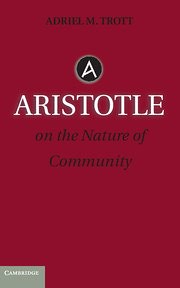
Aristotle on the Nature of Community reviewed at Bryn Mawr Classical Review

Lee Trepanier reviews my book at the Bryn Mawr Classical Review 2014.11.18

Adriel M. Trott’s Aristotle on the Nature of the Community examines Aristotle’s Politics by placing his understanding of nature (physis) at the center of political life. According to Trott, the human being and the polis operate according to natural ends which allow both entities to fulfill their nature, although the political ends of both the citizen and the polis will always remain incomplete as citizens will continually deliberate among themselves over the political community’s goals. By reclaiming nature at the center of political life, the book makes a substantial contribution to our understanding of Aristotle’s political thought and how it could be applicable to contemporary political questions of citizenship, democracy, and community.

Read More

Policing Philosophy’s Borders No More

Four stories:

1.  At a conference several years ago I found myself in an argument with a philosopher who works in an area of philosophy commonly dismissed as not philosophy.  We were considering the claim a third party had made that a fourth party’s work was not philosophy.  I agreed that the third party’s claims were dubious, “But,” I asked, “Don’t you think we need to make some distinctions between what is or is not philosophy?  Otherwise the original and specific contributions of philosophy will be disregarded.” Read more

#SPEP14

Last weekend, the annual meeting of the Society for Phenomenology and Existential Philosophy, the umbrella organization for continental philosophy in North America was held in New Orleans.  New Orleans is a fantastic city.  I had never visited before, so I had an impression that was kitschy.  But I left thinking it was beautiful.  I stayed in the Garden District.  My first morning there I took the streetcar to the conference hotel and the driver of the streetcar got out of the streetcar and went into a hotel and was gone for five minutes.  As a friend said, “Union break, don’t h8.”  The city was loud and colorful and much better than anything I had ever learned from The Pelican Brief about what the city would be like.

SPEP was all a-Twitter® and I storify it here.  In this post, I want to give a more sustained consideration to two panels I attended, two papers in particular: Sara Brill’s “Beyond Zôê and Bios: On the Concept of Shared Life in Aristotle’s Ethics” and Robin James’ remarks at the Advocacy Committee’s New Media, Social Networks and Philosophy panel.* Read more

Object Oriented Phiasco

The quickly burgeoning philosophy blogosphere has made it possible for philosophers to have more low-stakes discussions and debates not only about their work, but about the field.  In my view, this has largely been a good thing.  I live in small town in Indiana.  Up until about fifteen months ago, I lived in deep south Texas.  Sometimes the philosophy world feels far away.  I’m glad to be able to see what other people are thinking about and to engage, sometimes just as a voyeur, in these discussions and debates.  I’m also invested in digital humanities and the idea that we can lower the barriers that prevent non-academics from participating in these engagements. Read more

Trott Earns GLCA Grant

The Wabash News announces the GLCA grant I won with some colleagues in Indiana and the GLCA to collaborate on research and teaching projects in ancient philosophy.


The Danger of Justice Done OR Why We Need a Bad Conscience

It’s been a hectic couple weeks in the various institutions that concern my life.  The discipline of philosophy reached a boiling point and some well-respected important philosophers finally said enough is enough and organized some collective action to put a stop to some pretty unethical behavior.  Leigh Johnson has blogged an Archive of the Meltdown if you want to read more about it.  And Wabash has been actively responding to some pretty serious issues that needed to be addressed at the same time.

I’m glad for these actions, but I’m worried, too.  I think there is a danger when we do what is just to congratulate ourselves a little too excitedly and to let that congratulations become an avenue for contentment and self-satisfaction.  I was reminded yesterday of a point Jacques Derrida makes about how our acts of hospitality and justice are–I want to go further and say must be–accompanied by a bad conscience.  Derrida recognizes that when he feeds the poor or gives a place to stay to someone in need he is leaving out all the other hungry and all the others with no place to lay their heads.  Responding to one Other gives that Other precedence over all the other equally demanding Others to whom we are responsible.  To suppose that we are good in these moments leaves out two important things: a) that our act was too little too late, almost inevitably and b) that there is still more to be done. Read more

Curating for the Public Philosophy Journal

This week I was the guest curator-at-large for the Public Philosophy Journal.  The Public Philosophy Journal is a website and blog that aims to facilitate public philosophy in the many ways that term could be understood.  One way we understand public philosophy is that public issues and concerns can be served by philosophy’s input and analysis.  Part of that work is bringing content of note to the attention of both philosophers and public servants or others who are working on these issues. I understood such content to concern public issues that philosophy can and does address such as an article in The Globe and Mail about a new study that locates the causes of anorexia nervosa in the passions and suggests a passion-based cure.  The Greeks were themselves very interested in how the care of self was a matter of fostering the passions in the right way, so this convergence of old philosophical ideas and health seemed a good example of public philosophy.  This content also includes references to issues or events that have had influence on philosophy, like Alison Bechdel winning a MacArthur genius award for the Bechdel Test  she invented as a standard to expose how films rarely depict women as characters in themselves unrelated to the men their roles support.  Not only was that important in its own right as a provocative strategy for raising feminist concerns, but Bechdel also influenced the field of philosophy itself, prompting Helen de Cruz to suggest a Bechdel test for philosophy papers.  Another kind of notable content includes philosophers and theorists discussing public issues, such as Avi Alpert’s interview with Gabe Rockhill and Nato Thompson about art and politics and Lisa Guenther on television discussing protests against prisons and the death penalty in Tennessee.  Finally, there is the discussion of public issues within the field of philosophy, issues like being differently-abled in the field or the persistence of rape culture in philosophy departments.  Sometimes public philosophy can even be philosophers taking their work to more public arenas or philosophers being discussed in those arenas, as when Gregory Fried wrote about Heidegger’s Black Notebooks in the LA Times.  I wasn’t focusing on any one of these in particular, but all of them together. Read more

The Gods Must be Crazy and So is Nature

I asked my students to write a paper explaining how Zeus in Hesiod’s Theogony is a model of what a standard for nature is, what such a standard reveals about Hesiod’s view of nature or “the way things are”, and what is difficult about establishing a standard for how things are. I decided I would do this assignment, too, to give them a sense of what I am looking for and for an opportunity to continue blogging about Greek mythology. Read more